
Your Gateway to Growth and Success!
Your Gateway to Growth and Success!


ajay kumar
raasiswt@gmail.com
9696951934
Lucknow Lucknow - 226010
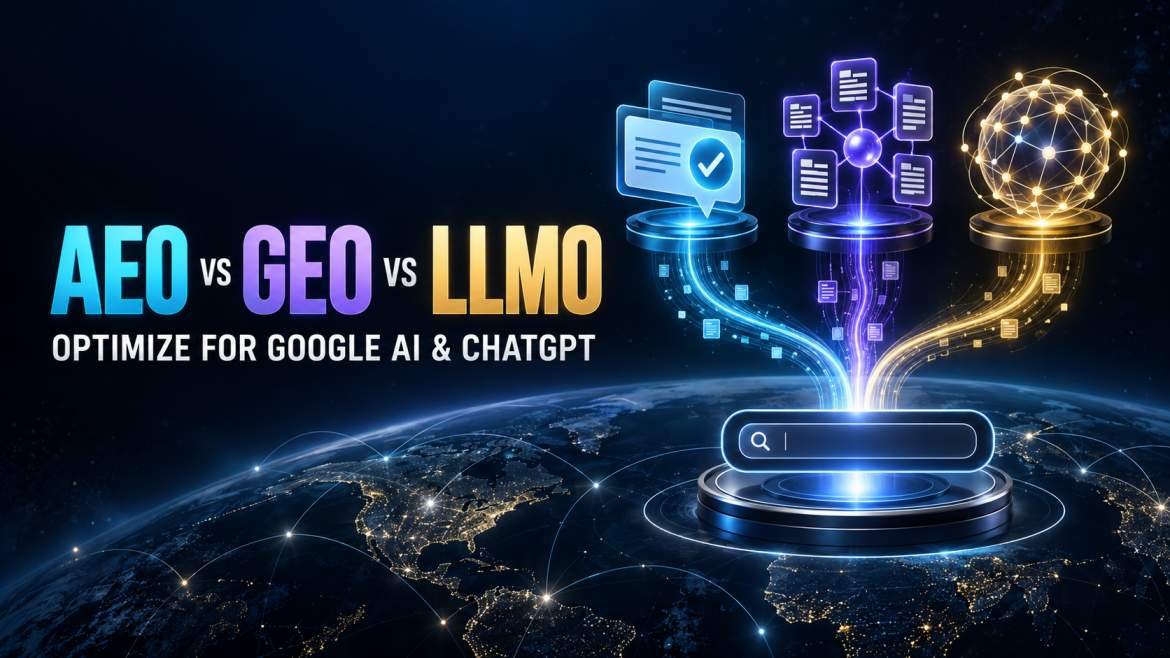
AEO vs GEO vs LLMO describes three connected approaches to modern search visibility. AEO structures content to deliver direct answers. GEO improves a source’s likelihood of being referenced in generative AI responses. LLMO helps large language models discover, understand and retrieve brand information accurately. Businesses should not choose only one. The strongest strategy combines traditional SEO, concise answers, authoritative evidence, entity clarity, technical accessibility and measurement across Google Search, AI Overviews, ChatGPT, Gemini, Perplexity and Microsoft Copilot.
Key Takeaways
AEO optimizes content for direct, concise answers.
GEO improves visibility and citations in generative search experiences.
LLMO helps language models interpret and retrieve information accurately.
Traditional SEO remains the technical and discovery foundation.
Original evidence and clear entities strengthen all three disciplines.
AI visibility should be measured alongside traffic and conversions.
No optimization method can guarantee a ranking or AI citation.
Definition Box: AEO, GEO and LLMO are complementary search-optimization disciplines. AEO targets answer surfaces, GEO targets inclusion in generative responses, and LLMO improves machine understanding and retrieval. Together, they help authoritative content become discoverable, extractable, accurately represented and commercially useful across conventional and AI-powered search.
AEO vs GEO vs LLMO: What Does Each Term Mean?
The simplest difference is the outcome each discipline emphasizes:
AEO: Become the clearest answer.
GEO: Become a trusted source in a generated response.
LLMO: Become understandable and retrievable by language-model systems.
The boundaries are not rigid. A well-structured answer may support a featured snippet, an AI Overview and a ChatGPT citation simultaneously.
What is AEO?
Answer Engine Optimization is the process of structuring content so search platforms can identify a direct response to a question.
AEO commonly uses question-based headings, concise answer paragraphs, definitions, lists, tables and step-by-step instructions. It is useful for featured snippets, voice search, People Also Ask results, support content and other answer-oriented surfaces.
What is GEO?
Generative Engine Optimization improves the likelihood that content will inform or be cited within an AI-generated response.
GEO emphasizes original information, verifiable claims, expert perspectives, source attribution, topical completeness and passages that retain their meaning when extracted from a longer page.
What is LLMO?
Large Language Model Optimization focuses on helping LLM-powered systems identify entities, understand relationships and retrieve the correct information for a user’s prompt.
It includes entity consistency, accessible HTML, semantic structure, clear product or service facts, crawler controls and unambiguous explanations.
These definitions describe practical areas of emphasis rather than official universal standards. Platforms do not publish a single “AEO score,” “GEO algorithm” or “LLMO ranking factor.”
Why AEO, GEO and LLMO Matter for Google AI and ChatGPT
Search journeys are becoming conversational. A user might begin with “What is AI SEO?” and continue with:
Which strategy is right for a small business?
How is it different from conventional SEO?
What should we implement first?
Which provider has relevant expertise?
How will we measure results?
A single AI session can move from awareness to comparison and purchase consideration. Brands must therefore be visible not only for isolated keywords but also for the questions, attributes and relationships involved in a decision.
Google explains that AI Overviews and AI Mode may use “query fan-out,” issuing multiple searches across related subtopics and data sources. It also says established SEO practices remain relevant and that no special AI schema or AI text file is required for inclusion. Google Search Central
This changes the role of content. A page must still deserve organic visibility, but it should also contain clear passages that can support complex, multi-part answers.
AI visibility may influence the buyer before a website visit occurs. A cited comparison, definition or recommendation can create recognition and trust. When the user eventually clicks, they may arrive with a more specific need and stronger intent.
AEO vs GEO vs LLMO Comparison: Goals, Tactics and Channels
The three disciplines are easiest to understand when compared with traditional SEO.
Area
Primary goal
Main tactics
Typical surfaces
Useful metrics
Main risk
Traditional SEO
Earn organic search visibility
Technical SEO, intent, content and links
Google and Bing results
Rankings, impressions, clicks and conversions
Prioritizing rankings over user value
AEO
Deliver the clearest direct answer
Definitions, FAQs, lists and concise responses
Featured snippets, voice and answer boxes
Answer visibility and qualified clicks
Producing answers without sufficient depth
GEO
Earn inclusion in generative responses
Evidence, citations, originality and completeness
AI Overviews, AI Mode and Copilot
Citations, cited pages and AI referrals
Publishing generic summaries
LLMO
Improve machine interpretation and retrieval
Entity clarity, semantic structure and accessible content
ChatGPT, Gemini, Perplexity and LLM applications
Brand mentions, retrieval accuracy and referrals
Assuming one format works for every model
Entity SEO
Clarify people, brands and products
Consistent facts, profiles and corroboration
Knowledge systems and AI answers
Brand-query growth and accurate mentions
Inconsistent information across sources
Conversion SEO
Turn visibility into business outcomes
Intent-aligned UX, proof and CTAs
Landing pages and commercial content
Leads, sales and assisted conversions
Measuring traffic without commercial impact
Technical SEO
Make content accessible and indexable
Crawling, rendering, canonicals and performance
All search and retrieval channels
Indexation, crawl health and Core Web Vitals
Blocking bots or hiding critical content
The correct strategy is not “AEO instead of SEO” or “GEO instead of LLMO.” Traditional SEO creates discoverability. AEO improves answer clarity. GEO builds citation readiness. LLMO strengthens machine understanding.
A business that neglects any one layer may create an avoidable weakness. An excellent answer cannot perform if it is blocked from crawling. A technically perfect page will not be cited if it offers nothing useful or distinctive.
How Answer Engine Optimization Improves Direct Answers
AEO begins with a real question and a direct response.
The strongest answer-first sections usually follow this pattern:
Ask a specific question in the heading.
Answer it in one or two opening sentences.
Expand with context, conditions and examples.
Use a list or table when it improves comprehension.
Link to a deeper supporting resource where appropriate.
For example, a weak answer says, “GEO is important for companies that want better AI results.”
A stronger answer says, “Generative Engine Optimization improves how clearly and credibly a company’s content can support AI-generated responses. It typically involves original evidence, descriptive headings, authoritative sourcing, consistent entities and self-contained passages.”
The stronger version defines the concept, describes its purpose and identifies its components.
AEO should not reduce every subject to a 40-word paragraph. Concise answers attract attention, but detailed supporting content builds understanding and trust. Use the short answer as the entry point, then address follow-up questions and practical limitations.
Soft CTA: If your pages rank but rarely earn featured answers or AI visibility, RAASIS TECHNOLOGY can assess whether unclear structure, weak intent alignment or missing evidence is limiting their performance.
How Generative Engine Optimization Builds AI Citations
GEO focuses on whether a page is useful enough to support a generated answer.
AI systems often synthesize information from multiple sources. A page is more citation-ready when its claims are specific, attributable, current and understandable outside the surrounding article.
Strengthen information gain
Do not merely rewrite what already ranks. Add something meaningful:
Original research or first-party data
First-hand implementation experience
A proprietary framework
A detailed comparison
Expert commentary
A real case study
Clearly explained limitations
A tested process or checklist
Google’s people-first content guidance encourages original reporting, substantial analysis, demonstrable experience and clear authorship. It warns against producing content primarily to manipulate rankings or meet an arbitrary word count. Google Search Central
Create citation-ready passages
A useful passage contains the claim, context and qualification together.
Instead of writing, “AEO produces better results,” explain which results, under which conditions and how they should be measured. Avoid unsupported superlatives and invented statistics.
Cite primary sources wherever possible. If exact evidence is unavailable, label a statement as an observation or recommendation rather than presenting it as established fact.
How Large Language Model Optimization Improves AI Understanding
LLMO reduces ambiguity around a brand and its information.
Imagine an agency website that describes the same service as “AI SEO,” “future search marketing,” “GEO solutions” and “smart visibility” without defining the relationship among them. A reader may infer the meaning, but a retrieval system has to resolve unnecessary ambiguity.
An LLMO-focused page states:
What the service is
Who provides it
Who it is intended for
What problems it addresses
What deliverables are included
How it differs from adjacent services
Where the company operates
Which evidence supports its expertise
Entity consistency is especially important. Use stable names for the organization, people, services and products. Connect author biographies, About pages, service pages, case studies and trusted external profiles.
OpenAI advises publishers to allow OAI-SearchBot if they want their content considered for ChatGPT search summaries and links. OpenAI treats search discovery and potential model training as separate controls, with GPTBot used for the latter. OpenAI Publisher Guidance
Perplexity likewise documents PerplexityBot as its search crawler and provides bot and IP information for webmasters. Perplexity Documentation
How to Combine AEO, GEO and LLMO in One Content Strategy
A unified workflow prevents teams from producing separate, repetitive content for each acronym.
1. Start with audience tasks
Gather real questions from sales conversations, customer support, Search Console, internal site search and market research. Group them by awareness, comparison, implementation and decision intent.
2. Map entities and relationships
Define the people, products, services, locations and concepts the page must clarify. Use consistent terminology while explaining genuine synonyms naturally.
3. Build an answer-led outline
Place the central answer near the top. Use descriptive H2s for major questions and H3s for narrower follow-ups.
4. Add information gain
Include practical experience, evidence, examples, comparisons or original insight. Review every important claim for accuracy and attribution.
5. Improve passage independence
Read each section without the rest of the article. If the answer becomes unclear, add the missing context.
6. Connect the topic cluster
Use internal links to relevant service, comparison, case-study and implementation pages. Avoid forcing every page to rank for the same intent.
7. Add an intent-matched CTA
Informational readers may want a checklist or audit. Commercial readers may be ready for a consultation.
Common mistakes to avoid
Treating AI optimization as keyword stuffing
Publishing large volumes of generic AI-generated copy
Creating a page for every minor query variation
Inventing sources, statistics or client results
Hiding important facts inside images or scripts
Adding structured data that conflicts with visible content
Changing publication dates without meaningful updates
Promising guaranteed rankings or citations
The practical test is simple: does the page help the intended reader complete a task more confidently than competing resources?
Technical SEO Foundations for AEO, GEO and LLMO
AEO, GEO and LLMO depend on a technically accessible website.
Verify crawling and indexing
Review:
Robots.txt directives
Meta robots tags
Canonical URLs
XML sitemaps
HTTP status codes
JavaScript rendering
Internal-link depth
CDN and firewall rules
Mobile usability
Indexation reports
Google requires a page to be indexed and eligible to appear with a snippet before it can be shown as a supporting link in AI Overviews or AI Mode. Google does not guarantee crawling, indexing or inclusion, even when a page follows best practices.
Keep essential content in HTML
Important definitions, service details, specifications and evidence should be available as text. Do not make an infographic, video or PDF the only source of essential information.
Use semantic HTML, descriptive anchors, accessible menus and meaningful alternative text. Accessibility improvements can also make interface purpose and content structure easier for automated systems to interpret.
Use accurate structured data
For blog content, valid Article or BlogPosting schema can clarify the headline, author, images and publication dates. Organization, Person, Product or Service markup may be appropriate elsewhere when it matches the visible page.
Schema improves explicitness; it does not manufacture authority or guarantee an AI citation.
Maintain strong page experience
Compress images, define media dimensions, reduce unnecessary scripts, cache efficiently and monitor real-user performance. Google’s recommended “good” Core Web Vitals thresholds remain LCP within 2.5 seconds, INP below 200 milliseconds and CLS below 0.1. Google Search Central
How to Measure AEO, GEO and LLMO Performance
A modern reporting model should connect visibility with business impact.
AEO metrics
Featured-snippet appearances
People Also Ask visibility
Question-query impressions
Click-through rate
Engagement with answer-led pages
GEO metrics
Mentions in generated responses
Linked and unlinked citations
Number of cited URLs
Prompt-category visibility
AI referral sessions
LLMO metrics
Accuracy of brand and service descriptions
Entity consistency
Retrieval of priority pages
AI crawler activity
Visibility across representative prompts
Business metrics
Qualified leads
Demo or consultation requests
Assisted conversions
Revenue from AI referrals
Branded-search growth
Returning visitors
OpenAI says ChatGPT referral URLs include utm_source=chatgpt.com, which can support referral analysis. Microsoft’s Bing Webmaster Tools introduced AI Performance reporting in 2026, including total citations, cited pages, grounding queries and citation trends. Microsoft Bing
Build a fixed set of representative prompts by topic, audience and funnel stage. Test them periodically, but do not present one manually observed answer as a permanent ranking. AI responses can vary by wording, context, platform, geography and freshness.
Soft CTA: RAASIS TECHNOLOGY can help establish a practical AI-search measurement framework connecting citations and brand visibility with qualified traffic, leads and revenue.
Why RAASIS TECHNOLOGY for AEO, GEO and LLMO
RAASIS TECHNOLOGY approaches AI search as an integrated content, technical and conversion challenge. That matters because optimizing headings without fixing crawl access—or earning citations without building a conversion journey—produces incomplete results.
A tailored engagement may include:
SEO, AEO, GEO and LLMO visibility audit
Technical crawl and indexation review
Customer-question and prompt research
Entity and topical-authority mapping
Content-gap and competitor analysis
Answer-first content architecture
Editorial briefs and content optimization
Structured-data validation
AI crawler and firewall review
Citation and referral measurement
Conversion-focused landing-page recommendations
Next Steps Checklist
Define priority audiences, services and conversion goals.
Collect real customer questions across the buying journey.
Audit crawlability, indexation and mobile performance.
Identify duplicate, outdated or low-value content.
Add direct answers beneath descriptive headings.
Strengthen claims with evidence and first-hand expertise.
Standardize brand, author and service entities.
Verify relevant search and AI crawler access.
Add accurate structured data where appropriate.
Track citations, referrals, engagement and conversions.
Review priority content whenever facts materially change.
The central lesson of AEO vs GEO vs LLMO is that businesses do not need three disconnected strategies. They need one authoritative information system that search engines can discover, answer engines can extract, generative systems can cite and language models can interpret accurately.
Ready to improve visibility across Google Search, AI Overviews, ChatGPT, Gemini, Perplexity and Microsoft Copilot? Explore RAASIS TECHNOLOGY’s AI SEO services and request a tailored AEO, GEO and LLMO strategy for your brand.
Frequently Asked Questions
1. What is the main difference between AEO, GEO and LLMO?
AEO focuses on making content suitable for direct answers, such as featured snippets and question-based results. GEO focuses on earning inclusion or citations within generative AI responses. LLMO improves how language-model systems understand entities, relationships and retrievable passages. They overlap significantly, so businesses should combine them with conventional SEO instead of treating them as competing or mutually exclusive services.
2. Is GEO replacing traditional SEO?
No. GEO depends heavily on the same foundation as SEO: crawlable pages, indexation, useful content, internal links, authority and strong user experience. GEO adds emphasis on evidence, information gain, passage clarity and generative citations. Google explicitly says its existing SEO best practices continue to apply to AI Overviews and AI Mode. Businesses should extend their SEO strategy for generative discovery rather than abandon traditional organic optimization.
3. Should a small business prioritize AEO, GEO or LLMO first?
A small business should first secure its technical SEO and core service content. It can then apply AEO by directly answering customer questions, GEO by adding trustworthy evidence and distinctive expertise, and LLMO by clarifying its brand, services, locations and authors. These improvements can often be applied to the same priority pages. Begin with content closest to revenue instead of attempting to optimize the entire website simultaneously.
4. How do I optimize content for Google AI Overviews?
Create indexable, people-first content that addresses the complete search intent. Put concise answers beneath descriptive headings, provide supporting detail, demonstrate experience, cite primary evidence and ensure structured data matches visible content. Use internal links so Google can discover related pages. Google says no special AI schema or AI-specific text file is required, and compliance with best practices does not guarantee inclusion in an AI Overview.
5. How can my website appear in ChatGPT search?
Make the website publicly accessible, publish clear and trustworthy information, and ensure OAI-SearchBot is not unintentionally blocked by robots.txt, CDN settings or firewall rules. Use meaningful HTML, descriptive headings, consistent entities and strong source attribution. OpenAI notes that allowing its search crawler supports discovery, summaries and links. Accessibility improves eligibility, but it does not guarantee that ChatGPT will cite a specific page for every relevant prompt.
6. How long does AEO, GEO or LLMO take to work?
There is no universal timeline. Technical corrections may be detected after search and AI crawlers revisit the site, while authority, recognition and durable citation visibility can take longer. Results depend on competition, existing domain strength, crawl frequency, content quality and platform behavior. Establish a baseline, prioritize high-value pages and assess monthly trends across citations, impressions, referrals, qualified leads and conversions rather than expecting an immediate fixed ranking.
7. Can an agency guarantee a number-one ranking or AI citation?
No credible agency can guarantee a specific Google ranking, AI Overview placement or ChatGPT citation. These platforms control their own systems and may generate different responses according to context, query wording, freshness and location. A professional strategy can improve technical eligibility, content relevance, answer clarity, evidence and authority. Success should be evaluated through sustained gains in qualified visibility, accurate mentions, citations, engagement and commercial outcomes.