
Your Gateway to Growth and Success!
Your Gateway to Growth and Success!


Ajay Chaudhary
raasiswt@gmail.com
9696951934
Lucknow Lucknow - 226010
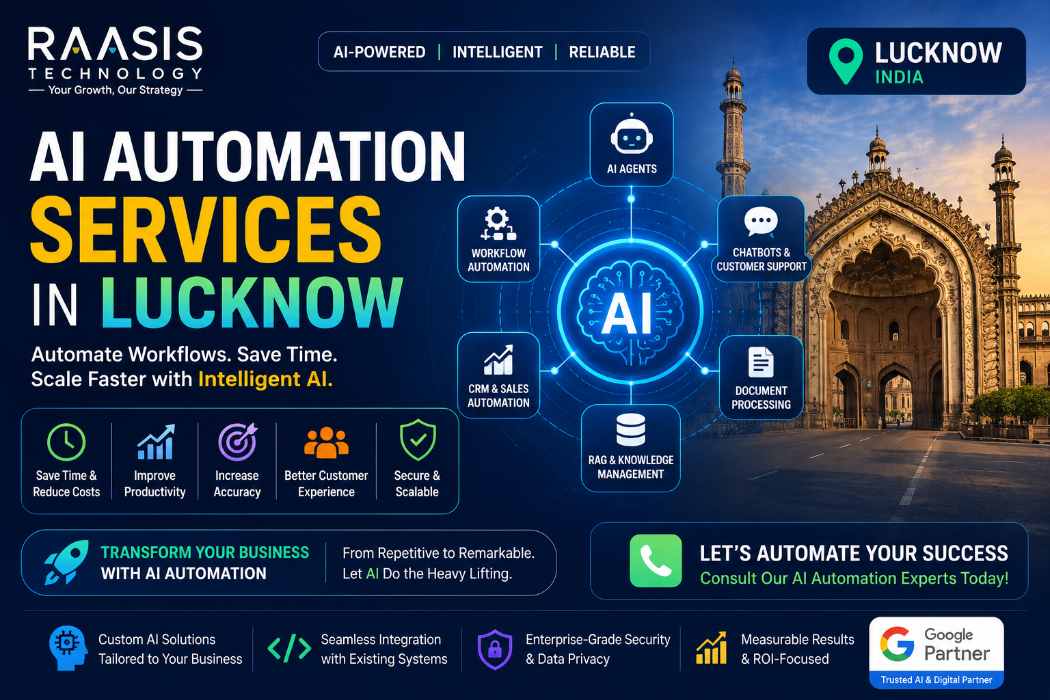
AI Automation Services in Lucknow help businesses automate repetitive and multi-step work using AI agents, workflow orchestration, APIs, chatbots, RAG knowledge systems and conventional automation. In 2026, practical use cases include lead qualification, CRM updates, appointment booking, customer-support triage, document processing, internal knowledge retrieval and reporting. The strongest implementations do not give AI unlimited control: they use scoped permissions, human approval for consequential actions, monitoring, evaluation and audit logs to make automation reliable enough for production.
Key Takeaways
AI automation has moved beyond generating text toward completing business workflows.
Not every workflow needs an AI agent; predictable rules should often remain deterministic.
High-value automation usually begins with repetitive, measurable processes that consume staff time or lose enquiries.
AI agents can connect with CRMs, calendars, support tools, databases, WhatsApp and internal applications.
Sensitive actions such as payments, deletion, publishing or permission changes should normally require human approval.
RAG can ground AI responses in approved business documents and knowledge.
ROI should be measured through completed work, response time, conversion, error rates and operating cost—not the number of AI prompts processed.
Definition Box — What Is AI Automation?
AI automation combines artificial intelligence with workflow software, APIs and business systems so software can interpret information, make bounded decisions and perform actions automatically. Unlike conventional automation, which generally follows predefined rules, AI-enabled workflows can handle unstructured text, documents and variable situations. Production systems still need permissions, validation, human escalation and measurable operating limits.
1. What Are AI Automation Services in Lucknow in 2026?
AI automation has evolved considerably from the first wave of business chatbots.
The earlier model was largely:
Employee asks AI → AI generates an answer → employee performs the work.
Modern agentic automation can instead look like:
Event occurs → system gathers context → AI determines the next permitted step → tools execute actions → system validates the result → human approves when necessary → workflow continues.
OpenAI describes this broader enterprise shift as a move from assistance toward delegation and execution, where agents receive company context and tools to complete substantive workflows rather than merely answer questions.
AI automation versus conventional automation
Conventional automation remains excellent for predictable logic.
For example:
If payment status becomes “paid,” send invoice email.
That does not necessarily require an LLM.
AI becomes useful where the workflow contains ambiguity:
Read a customer enquiry, understand what service they need, extract budget and location, check whether the enquiry meets qualification rules, create the CRM record and route it to the correct sales representative.
The most reliable architecture often combines both.
Use normal code for fixed rules and AI where language understanding, classification, summarization or contextual judgement adds value.
RAASIS TECHNOLOGY's current AI development methodology reflects this approach: feasibility first, model selection according to workload, integration with existing business systems and human oversight rather than adding AI simply to appear innovative.
2. Why Businesses in Lucknow Are Adopting AI Workflow Automation
The strongest reason to automate is not “because AI is trending.”
It is because a specific workflow is consuming too much time, introducing avoidable delay, creating errors or leaking revenue.
Imagine a Lucknow service business receiving enquiries from:
website forms;
WhatsApp;
Instagram;
phone callbacks;
paid campaigns.
Without automation, employees may copy the same information into a CRM, assign leads manually, send repetitive replies and remember follow-ups independently.
An automated workflow can help standardize this process.
Where automation creates value
Good candidates typically have several characteristics:
repeated frequently;
follow a recognizable sequence;
involve digital information;
have measurable outputs;
currently create delay or manual effort.
Examples include:
Lead operations
Capture, classify, enrich, score and route enquiries.
Support
Categorize requests, retrieve approved answers and escalate complex cases.
Operations
Extract information from documents, generate summaries and trigger downstream tasks.
Internal reporting
Gather approved data, prepare reports and distribute them on a schedule.
Lucknow location does not limit the workflow
A company operating in Lucknow may sell across India or internationally.
Its automation architecture can connect cloud systems used by teams in multiple locations.
The relevant question is therefore not:
“Can AI automate a Lucknow business?”
It is:
“Which processes inside this business are sufficiently repetitive, valuable and controllable to automate safely?”
Soft CTA: Before investing in a large AI platform, identify one workflow that either consumes significant employee hours or consistently loses qualified opportunities. A narrowly scoped pilot provides a more useful business case than automating five processes simultaneously.
3. What Can an AI Automation Company in Lucknow Actually Automate?
AI automation should be mapped to business outcomes.
Workflow
AI Automation Example
Primary Outcome
Lead management
Qualify and route incoming enquiries
Faster sales response
CRM operations
Create/update structured customer records
Less manual data entry
Customer support
Categorize requests and draft grounded answers
Faster resolution
Appointment workflow
Check availability and schedule meetings
Reduced coordination
Document processing
Extract, classify and summarize documents
Lower admin workload
Internal knowledge
Answer staff questions from approved documents
Faster information access
Ecommerce
Categorize support, returns or product enquiries
Operational efficiency
Reporting
Gather data and create recurring summaries
Faster management reporting
Content operations
Transform approved source material into drafts
Production efficiency
Follow-up
Trigger reminders based on CRM status
Reduced lead leakage
Sales automation
A sales automation agent might:
receive a website or WhatsApp enquiry;
identify service interest;
extract contact information;
ask approved qualifying questions;
create a CRM record;
assign the lead;
schedule a consultation;
notify a salesperson.
The workflow is valuable because it reduces response delay—not because AI generated a conversation.
Finance and administration
AI can support:
invoice classification;
document extraction;
reconciliation preparation;
approval routing;
management summaries.
Financial approval or payment execution should generally remain behind deterministic controls and explicit authorization.
Marketing operations
Useful automation can include:
lead-source classification;
campaign-report summaries;
content repurposing;
audience-question clustering;
CRM segmentation.
The right principle is simple:
Automate repetitive work; keep consequential judgement accountable.
4. How AI Agents and Workflow Automation Work Together
An AI agent is different from a conventional chatbot because it can use tools and take actions.
A production agent may have access to:
CRM;
calendar;
support platform;
email;
database;
internal search;
APIs.
OpenAI's current workspace-agent model similarly describes agents that can run recurring workflows, use connected tools and take actions under organizational permissions and approval controls.
A practical AI automation architecture
Think of the system as six layers.
1. Trigger
An event starts the workflow.
Example: a new lead arrives.
2. Context
The system retrieves relevant customer, company or policy information.
3. Reasoning
The model interprets the situation within defined limits.
4. Tools
The agent can invoke approved APIs or functions.
5. Control
Rules enforce permissions, approvals, spending limits and prohibited actions.
6. Logging and evaluation
Every important step can be reviewed and measured.
When not to use an AI agent
Do not use an LLM simply because an API exists.
If a workflow is:
deterministic;
mathematically exact;
safety-critical;
already handled reliably by existing software;
ordinary automation may be better.
For example, calculating GST from predetermined values should normally use code—not model reasoning.
AI is most useful around unstructured or variable information, while deterministic systems remain preferable for exact business logic.
5. AI Chatbots, WhatsApp Automation and Customer Service Workflows
Chatbots remain valuable, but the 2026 version should do more than answer generic questions.
A customer-facing AI assistant can:
answer approved FAQs;
understand service intent;
qualify enquiries;
collect structured information;
check availability;
book appointments;
create CRM records;
transfer conversations to employees.
RAASIS's current conversational-AI service architecture emphasizes grounded answers, CRM integration and deliberate human handoff rather than leaving the assistant to improvise indefinitely.
Why WhatsApp matters in India
For many Indian businesses, the fastest conversion channel is messaging rather than email.
A useful workflow may therefore be:
Ad → landing page → WhatsApp → AI qualification → CRM → human sales representative
The customer receives an immediate response while the business receives structured lead data.
Human handoff should be designed early
A good AI assistant knows when not to continue.
Escalation conditions might include:
customer complaint;
uncertain answer;
high-value opportunity;
payment dispute;
special pricing request;
regulated advice.
The automation should preserve the conversation context so the customer does not need to repeat everything when a person takes over.
That is better customer experience than building a bot that attempts to answer every possible question.
6. Enterprise AI Automation Architecture, RAG and Business Integrations
Enterprise automation becomes powerful when AI receives the right context.
That context might come from:
CRM records;
ERP systems;
product databases;
company policies;
knowledge bases;
support documentation;
contracts;
approved marketing information.
RAG keeps answers grounded
Retrieval-Augmented Generation, or RAG, allows an application to retrieve relevant information from an approved knowledge source before producing an answer.
For an internal assistant, that might mean:
“What is our refund process for enterprise customers?”
Instead of relying only on general model knowledge, the system retrieves the organization's current policy.
This improves maintainability and reduces unsupported answers.
Integration is where automation produces real value
A standalone AI interface can save some time.
An integrated workflow can complete work.
RAASIS's AI development practice explicitly positions integration with existing CRM, ERP, websites and applications as part of the production architecture rather than requiring businesses to replace their operational stack.
Model-agnostic architecture can reduce lock-in
Different steps may benefit from different technology.
A production workflow could use:
an advanced model for complex judgement;
a lower-cost model for simple classification;
embeddings for retrieval;
deterministic code for validation.
This makes cost and reliability easier to control than sending every task to the largest available model.
7. Security and Governance for AI Automation Services
An AI workflow becomes riskier once it can modify real systems.
A chatbot that produces a wrong sentence is one problem.
An agent that can send emails, delete data, issue refunds or change permissions creates a much larger operational risk.
Use least privilege
Agents should only receive access required for the specific workflow.
Microsoft's 2026 guidance recommends narrowly scoped access, per-tool authorization and fresh human confirmation for consequential actions such as sending, deleting, purchasing, deploying or modifying permissions.
Require approval for irreversible actions
A useful rule is:
AI may prepare; humans approve high-impact execution.
Examples include:
payment;
refunds;
deletion;
publishing;
contract commitments;
access changes.
Microsoft similarly recommends keeping humans involved wherever agents perform consequential actions affecting people, money or compliance.
Protect against prompt injection
OWASP identifies prompt injection as a major risk for LLM applications because malicious instructions can influence agent behavior or tool usage.
OWASP also highlights excessive agency—giving an AI system too much functionality, permission or autonomy—as a critical risk.
Production controls should therefore include:
scoped tools;
permission boundaries;
validation;
approval gates;
rate limits;
logs;
testing;
rollback mechanisms.
NIST's Generative AI Profile similarly frames trustworthy deployment around governing, mapping, measuring and managing risk across the AI lifecycle.
Security cannot be added after the agent receives production access.
8. AI Automation Services for SMEs, B2B, SaaS and Other Industries
Different organizations need different automation priorities.
SMEs and local businesses
Start with operational bottlenecks:
enquiries;
appointment scheduling;
follow-up;
customer FAQs;
reporting.
These workflows often deliver value without a large enterprise architecture.
B2B businesses
Useful automations include:
lead qualification;
account research;
CRM enrichment;
meeting preparation;
follow-up workflows;
proposal preparation assistance.
The objective is not replacing salespeople.
It is reducing administrative work so representatives spend more time with qualified prospects.
SaaS companies
SaaS automation can support:
onboarding;
support triage;
documentation retrieval;
product-feedback classification;
customer-success alerts;
internal engineering knowledge.
Publishers and bloggers
Possible workflows include:
content-source organization;
research summarization;
transcript processing;
metadata preparation;
internal linking recommendations.
Editorial approval should remain central.
Ecommerce
AI can assist with:
product enquiries;
support routing;
return classification;
review analysis;
merchandising assistance.
Healthcare and regulated services
Automation must be more conservative.
Administrative use cases such as appointment scheduling or document routing may be appropriate, while decisions carrying clinical, legal or regulatory consequences require substantially stronger governance and human oversight.
Soft CTA: A useful automation roadmap ranks potential workflows by value, frequency, error tolerance, data sensitivity and reversibility. Start where value is high and operational risk is manageable.
9. How to Measure ROI From AI Workflow Automation in Lucknow
An AI workflow should have a measurable reason to exist.
Do not measure success through:
number of prompts;
chatbot conversations;
API calls;
AI-generated documents.
Those are activity metrics.
Operational KPIs
Measure:
time saved per workflow;
average handling time;
response time;
automation completion rate;
manual intervention rate;
error rate;
cost per completed process.
Commercial KPIs
For customer-facing automation, track:
lead response speed;
qualification rate;
bookings;
conversion rate;
lost-lead reduction;
sales pipeline;
revenue influenced.
Quality KPIs
AI-specific monitoring can include:
unsupported-answer rate;
escalation accuracy;
tool-call failures;
policy violations;
human correction rate.
Common AI automation mistakes
Mistake 1: Automating a broken process
Automation makes a bad workflow faster.
Document the process first.
Mistake 2: Starting too large
A company may attempt to automate sales, support, marketing and finance simultaneously.
Start with a thin production slice.
Mistake 3: Giving the agent excessive access
Use least privilege and approval gates.
Mistake 4: No evaluation framework
A demo that worked ten times is not evidence of production reliability.
Mistake 5: No human fallback
Edge cases will occur.
Escalation must be part of the architecture.
OpenAI's current enterprise guidance similarly emphasizes evaluations, governance and continuous improvement when moving agents into high-value production workflows.
10. Why Consider RAASIS TECHNOLOGY for AI Automation in Lucknow?
Businesses searching for AI Automation Services in Lucknow should evaluate providers on their ability to connect AI with real operations—not on how many model names appear in a sales presentation.
Why RAASIS TECHNOLOGY
RAASIS TECHNOLOGY currently operates a broader AI Development & Automation practice covering:
custom AI development;
AI agents and workflow automation;
AI chatbot development;
RAG and knowledge-base AI;
generative AI and LLM development;
integrations with existing digital systems.
Its published approach is particularly useful for businesses that want to reduce implementation risk:
Feasibility first
Determine whether AI is actually the right tool.
Thin production slice
Deploy one useful workflow before expanding.
Integration first
Connect with the CRM, ERP, website, application or database already in use.
Controlled automation
Keep human approval around irreversible actions.
Ownership
RAASIS states that clients retain ownership of code, prompts, data and architecture within its custom AI development model.
The company also publishes a dedicated AI-agent architecture built around scoped tool access, durable workflow state, retry handling, model routing, approval gates and logging.
Important location clarification
RAASIS currently publicly lists offices in Delhi and Basti rather than a Lucknow office.
The service can therefore be positioned as AI automation services for businesses in Lucknow rather than claiming a physical Lucknow branch unless that office is formally established and published.
Next Steps Checklist
Identify the workflow consuming the most repetitive employee time.
Calculate its current monthly volume.
Estimate cost, delay and error impact.
Document the existing process step by step.
Separate fixed rules from judgement-based tasks.
Identify systems and APIs involved.
Classify sensitive business data.
Decide which actions require human approval.
Define the measurable output of the automation.
Build the smallest production-worthy pilot.
Test normal, ambiguous and malicious inputs.
Configure logs and monitoring.
Track completion rate and human intervention.
Measure operational and commercial ROI.
Expand only after the first workflow proves reliable.
The strongest AI Automation Services in Lucknow are not built around replacing employees or adding AI to every process.
They are built around identifying one valuable workflow, giving AI only the tools and permissions it actually needs, connecting it with existing systems, measuring completed work and keeping humans in control where decisions carry real consequences.
If your business has repetitive sales, support, operations, document or internal-knowledge workflows, explore RAASIS TECHNOLOGY and start with a focused AI automation feasibility assessment.
Automate the process—not the hype. Build one workflow that proves measurable value in production.
FAQs
1. What are AI automation services for businesses in Lucknow?
AI automation services use artificial intelligence, workflow software and APIs to automate business processes such as lead qualification, CRM updates, appointment scheduling, support triage, document processing and reporting. Unlike simple rule-based automation, AI can interpret unstructured language and variable information. The most reliable systems combine AI with deterministic rules, scoped permissions, monitoring and human approval for sensitive actions rather than allowing an agent unrestricted access to business systems.
2. How is an AI agent different from a chatbot?
A chatbot primarily holds a conversation and produces responses, while an AI agent can be authorized to use tools and perform multi-step actions. For example, a chatbot may explain available appointment slots; an agent could check the calendar, collect customer details, create the booking and update the CRM. Because agents can change real systems, they require stronger controls such as least-privilege access, logging and approval gates for consequential actions.
3. Which business processes are best suited for AI automation?
Good candidates are repetitive, high-volume processes with measurable outputs and manageable risk. Common examples include lead classification, customer-support routing, document extraction, appointment coordination, CRM data entry, internal knowledge retrieval and recurring reporting. Processes involving irreversible financial, legal, clinical or security decisions require greater human oversight. Businesses should begin with one well-defined workflow whose time, error rate or lost-opportunity cost can be measured before and after implementation.
4. Can AI automation integrate with our existing CRM, ERP or website?
Yes, provided the relevant systems offer APIs, webhooks or other supported integration methods. A production workflow can connect AI with CRM systems, calendars, databases, support platforms, ERP software, websites, applications and internal tools. RAASIS's current AI development architecture specifically focuses on integrating automation into systems businesses already operate rather than requiring complete platform replacement. The exact integration scope depends on access controls, APIs, data quality and workflow requirements.
5. Is AI workflow automation safe for confidential business data?
It can be designed securely, but safety depends heavily on architecture and governance. OWASP identifies risks including prompt injection, sensitive-information disclosure and excessive agent permissions. Good implementations use least-privilege access, explicit approval for high-impact actions, data boundaries, logging, validation and regular security testing. NIST's Generative AI risk guidance similarly recommends managing trustworthiness throughout the lifecycle rather than treating security as a one-time launch task.
6. How much do AI automation services in Lucknow cost?
There is no reliable single market price because an automated lead-routing workflow and a multi-system enterprise agent have very different requirements. Cost depends on the number of integrations, workflow complexity, model usage, data preparation, security, RAG requirements, UI development and ongoing monitoring. A better purchasing approach is to scope the smallest workflow capable of demonstrating measurable value, calculate its implementation and operating cost, and expand only when production results justify further automation.
7. Why choose RAASIS TECHNOLOGY for AI automation?
RAASIS TECHNOLOGY currently provides custom AI development, AI agents, workflow automation, conversational AI, RAG systems and LLM application development. Its published delivery model emphasizes feasibility analysis, small production pilots, integration with existing business systems, scoped permissions, approval gates and client ownership of the resulting code, prompts, data and architecture. For Lucknow businesses, it can therefore be evaluated as a remote AI automation implementation partner without implying a physical Lucknow office.