
Your Gateway to Growth and Success!
Your Gateway to Growth and Success!

Ajay Chaudhary
raasiswt@gmail.com
9015598750
Delhi, India 110018 Delhi - 110018
If you’re looking for a practical Data Science Roadmap and a modern AI Roadmap, here’s the simple truth: you don’t become “job-ready” by collecting certificates—you become job-ready by building repeatable skills and shipping real projects. This guide is designed to be informational, step-by-step, and portfolio-first, so you can progress from beginner to AI Engineer with clarity.
Data Science = extracting insights + building predictive models from data.
AI Engineering = building, evaluating, and deploying AI systems (often including ML + LLM apps) reliably in production.
Roadmap at a glance (timeline you can actually follow)
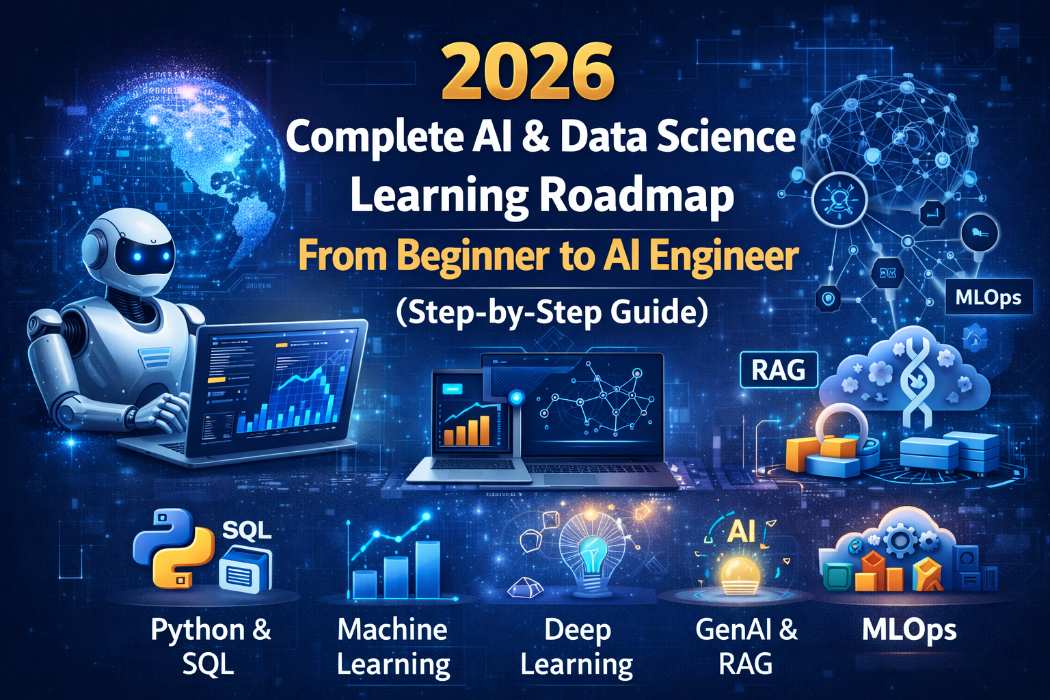
0–3 months: Python + SQL + EDA + core ML concepts
3–6 months: scikit-learn projects + model evaluation + storytelling
6–12 months: deep learning + LLM/RAG + MLOps + deployment basics
Helpful free learning anchors include Google’s updated ML Crash Course (with newer topics like LLMs and responsible AI).
Brand note: If you want a guided path, mentorship, and job-ready project execution support, RAASIS TECHNOLOGY (https://raasis.com) can help you turn this roadmap into an outcomes-based plan.
Data Science Roadmap 2026 at a Glance: Skills, Tools, and Timeline
The fastest way to get overwhelmed is to treat AI like one giant subject. Instead, treat it like a stack:
Layer 1 — Foundations: Python, SQL, math, Git
Layer 2 — Data work: cleaning, EDA, visualization, feature engineering
Layer 3 — Modeling: classical ML → deep learning → LLM apps
Layer 4 — Production: tracking, deployment, monitoring, governance
Which path should you choose?
Data Analyst → heavy SQL + dashboards + business metrics
Data Scientist → experiments + ML + insights storytelling
ML/AI Engineer → ML systems, APIs, deployment, reliability
The “don’t skip” rule
If your goal is employability in 2026, prioritize:
SQL + data cleaning (most jobs live here)
Model evaluation + leakage prevention (separates pros from dabblers)
Projects that show business impact (even simulated impact)
What you’ll build by the end:
A portfolio of 3–5 projects, one of which is production-like (API + monitoring basics)
AI Roadmap Step 1: Python, Git, Linux, and Math That Actually Matters
This step is about becoming operational—able to run experiments, manage code, and learn quickly.
Python essentials (for real DS work)
Data structures, functions, OOP basics
NumPy + Pandas workflow mindset (vectorization, joins/merges)
Writing clean notebooks and turning them into scripts
Git/GitHub (non-negotiable)
Recruiters trust engineers who can collaborate:
Branching, commit hygiene, PRs
README that explains problem, dataset, approach, results
A “repro steps” section (install → run → evaluate)
Math (minimum effective dose)
You don’t need a math degree. You do need:
Linear algebra: vectors, matrices, dot products
Probability: distributions, expectation, Bayes intuition
Calculus-lite: gradients (why learning works)
A structured intro like Google’s ML Crash Course is a strong foundation because it emphasizes core concepts + practical exercises.
Data Science Roadmap Step 2: SQL + Data Wrangling (The Job-Winning Core)
If you want a shortcut to being useful on day one: get great at SQL and data cleaning.
SQL checklist (interview + job-ready)
Joins (inner/left), GROUP BY, HAVING
Window functions (ROW_NUMBER, LAG/LEAD)
CTEs, subqueries, query readability
Data cleaning patterns you’ll use weekly
Missing values: drop vs impute (and why)
Outliers: detect → decide (remove/cap/keep)
Data leakage: ensure future info doesn’t sneak into training
Consistent types, units, and categorical values
EDA framework (fast + repeatable)
Define the question (business or product)
Inspect distributions + missingness
Segment (by time, user cohort, region, product)
Summarize insights + next hypotheses
For structured learning sprints, Kaggle’s micro-courses are practical and beginner-friendly.
AI Roadmap Step 3: Statistics, Experimentation, and Product Thinking
AI without measurement becomes guesswork. This step teaches you to think like someone who ships improvements.
What to learn (in order)
Descriptive stats → distributions → sampling
Confidence intervals (interpretation matters more than formulas)
Hypothesis tests (when to use; when not to)
A/B testing basics + common traps (peeking, multiple comparisons)
Product metrics mindset
Choose a primary success metric (north star)
Add guardrails (latency, cost, churn, fairness signals)
Define “good enough” before testing (pre-commit decisions)
This is where you start sounding senior in interviews: you can explain why a model is valuable, not just what it predicts.
Data Science Roadmap Step 4: Machine Learning Fundamentals (Models + Evaluation)
Now you build modeling confidence—without getting lost in deep learning too early.
Core ML map
Supervised learning: regression/classification
Unsupervised: clustering, dimensionality reduction
Time series: train/test splits by time, not random
Evaluation that hiring managers care about
Cross-validation strategies
Metrics selection (AUC vs F1 vs RMSE vs MAE)
Thresholding and calibration (especially for imbalanced data)
Tooling: scikit-learn as the workhorse
scikit-learn’s user guide is a gold standard for classical ML—pipelines, model selection, metrics, and more.
Deliverable project (recommended):
A “customer churn” or “loan default” style project with:
clean pipeline
leakage checks
explainability section (feature importance + limitations)
AI Roadmap Step 5: Deep Learning with PyTorch/TensorFlow (Modern AI Basics)
Deep learning becomes easier once classical ML is comfortable.
What to focus on
Neural network basics (forward pass, loss, backprop)
Optimization (SGD/Adam), regularization (dropout, weight decay)
Training loops, batching, and GPU basics
PyTorch starting point
PyTorch’s beginner tutorials cover the full workflow: data → model → optimization → saving.
TensorFlow/Keras starting point
TensorFlow’s beginner quickstart and basics guide are clean on-ramps to Keras-based training.
Deliverable project:
An image classifier or text classifier with:
train/val curves
error analysis (what fails and why)
simple experiment tracking notes
AI Roadmap Step 6: Generative AI + LLM Stack (Transformers, RAG, Evaluation)
In 2026, employers increasingly expect you to understand LLM-based applications—not just models.
Learn the building blocks
Transformer intuition: tokens, attention, embeddings
Prompt patterns: role + context + constraints + examples
Retrieval-Augmented Generation (RAG): grounding answers in documents
Hugging Face’s Transformers documentation is the most widely used reference for modern LLM workflows.
RAG in one page (snippet-friendly)
Ingest docs
Chunk + embed
Store vectors
Retrieve top-k
Generate with citations/grounding
Evaluate (accuracy + hallucination rate)
Evaluation and safety basics
Hallucinations: measure with test sets, not vibes
Prompt injection: sanitize, restrict tools, validate outputs
Cost + latency budgets (LLM apps are economics too)
Data Science Roadmap Step 7: Portfolio Projects That Get Interviews (Not Toy Demos)
Portfolios fail for one reason: they don’t prove decision-making.
4 project templates that “read senior”
Business prediction (churn/retention/forecasting) with clear ROI logic
Experiment analysis (A/B test simulation + metric design)
NLP/LLM app (RAG over docs with eval + guardrails)
Data engineering + ML (pipeline → model → API)
Kaggle strategy (practical + structured)
Use Kaggle Learn to build fundamentals fast, then do 1–2 competitions for credibility.
Case study writing (the hiring hack)
Every project should answer:
Problem + user impact
Dataset + limitations
Approach + why it’s reasonable
Results + error analysis
Next steps + monitoring plan
AI Roadmap Step 8: MLOps + Deployment (Ship Models Like an Engineer)
This is where you become an AI Engineer.
Experiment tracking + registry (baseline expectations)
MLflow provides tracking and a model registry to manage model lifecycle.
Minimum MLOps checklist:
Track runs (params, metrics, artifacts)
Save model + environment spec
Version datasets/features
Promote models via stages (dev → staging → prod)
Containers + orchestration
Docker: standard way to package and run apps consistently
Kubernetes: common platform for managing containerized workloads
Pipelines + big data (when needed)
Airflow: workflow orchestration platform (DAGs)
Spark: large-scale data processing engine, supports Spark SQL + MLlib
Deliverable project:
A small production-like system:
API endpoint for inference
Dockerfile
basic monitoring logs
MLflow tracking
How to Start a Data Science Career in 2026: Roles, Resume, Interview Plan
This is the practical game plan that gets you hired.
Role-based skill matrix (quick guide)
Data Analyst: SQL + dashboards + metrics + storytelling
Data Scientist: stats + ML + experimentation + product reasoning
AI Engineer: ML + LLM apps + deployment + reliability
Resume bullets that convert
Bad: “Built a churn model.”
Good: “Built churn prediction pipeline (AUC 0.xx), reduced false positives by X% via threshold tuning; documented leakage checks and monitoring plan.”
Interview practice (high ROI)
SQL drills (joins + windows)
ML fundamentals (bias/variance, CV, metrics trade-offs)
A/B testing reasoning
System thinking for ML apps (data drift, retraining, monitoring)
When to get help (to compress time)
If you want mentorship, project reviews, and an outcomes-driven plan, RAASIS TECHNOLOGY (https://raasis.com) can support:
personalized learning path
portfolio project selection and execution
interview prep + deployment coaching
Responsible AI (Must-Know in 2026)
Hiring teams increasingly care about safety and trust.
NIST’s AI RMF 1.0 is a widely referenced framework for managing AI risks across lifecycle.
Google and Microsoft publish responsible AI principles and approaches you can cite in case studies.
OECD AI principles are a global reference for trustworthy AI.
Add this section to every portfolio project: limitations, fairness risks, privacy notes, monitoring plan.
FAQs
What is the fastest way to follow a Data Science Roadmap?
Commit to Python + SQL first, then do 2 scikit-learn projects, then one deep learning or LLM project, and finally a deployment project.
Do I need a CS degree for an AI Roadmap?
No. You need consistent practice, strong fundamentals, and proof via projects + clear write-ups.
Which is better in 2026: PyTorch or TensorFlow?
Both are industry-standard; PyTorch is widely used in research and many production stacks, TensorFlow/Keras remains strong—pick one and ship.
How many projects are enough to get interviews?
Usually 3–5 strong projects, with at least one production-like deployment.
Is Kaggle necessary?
Not mandatory, but Kaggle Learn + one competition can boost credibility.
What is the easiest MLOps stack to start with?
MLflow for tracking + Docker for packaging + a simple API deployment path; add Kubernetes later if needed.
How do I stand out for AI Engineer roles?
Ship an LLM/RAG app with evaluation + guardrails and a deployment story (cost, latency, monitoring).
Content Summary
Follow a structured Data Science Roadmap: Python + SQL → ML → Deep Learning → GenAI → MLOps.
Use authoritative learning anchors (Google MLCC, scikit-learn, PyTorch, TensorFlow, Hugging Face).
Build 3–5 portfolio projects that prove decision-making and deployment ability.
Add Responsible AI framing using NIST/OECD/major vendor principles.
Want to turn this roadmap into a personalized 12-week execution plan with project reviews, deployment guidance, and interview prep? Work with RAASIS TECHNOLOGY: https://raasis.com