
Your Gateway to Growth and Success!
Your Gateway to Growth and Success!

Ajay Chaudhary
raasiswt@gmail.com
9015598750
Delhi, India 110018 Delhi - 110018
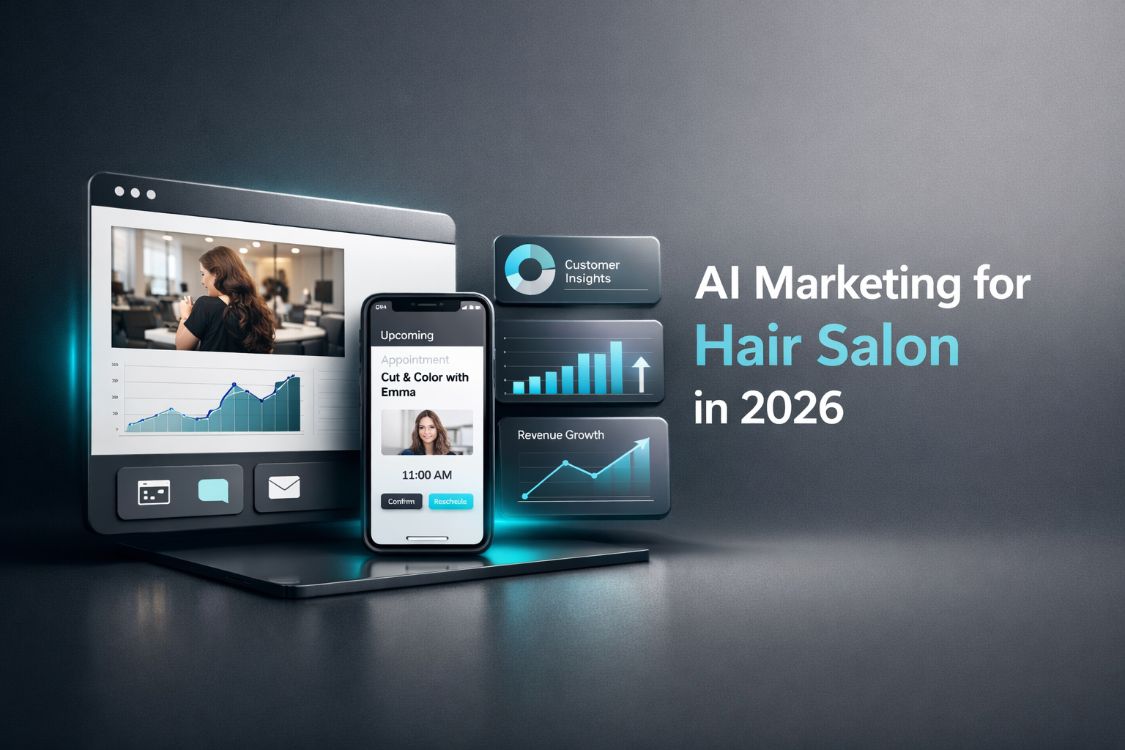
AI Marketing for salon in 2026 means using automation + predictive insights to attract local clients, convert inquiries faster, and keep chairs full—without spamming ads or sounding robotic. The winning approach is a connected stack: tracking + CRM + booking + messaging + creative workflows. Use AI to personalize offers, route leads, reduce no-shows, and trigger rebooking campaigns based on real behavior (searches, service history, timing). Pair it with clean SEO and measurable ads so you can scale reliably across locations and seasons.
To keep this guide actionable, you’ll see how to use AI-Driven Marketing Tools for Salons in a lean stack, how Salon and Spa Owners can deploy Beauty Salon AI Agents for faster conversions, and how modern AI Salon Systems That Run Salons support retention. We’ll also cover content workflows inspired by AI Marketing Tools for Beauty Brands, what the Future of AI in the Hair and Beauty Sector implies for search and privacy, and practical ways to Elevate Your Salon Business with smarter offers and loyalty.
Key takeaways
Connect your booking system, CRM, ads, and messaging first—AI works best with clean inputs.
Use AI to respond to inquiries in minutes and capture intent, service, budget, and preferred time.
Build retention automations: rebook reminders, post-visit care, and loyalty nudges.
Create content in batches with AI, then edit with your brand voice and real examples.
Optimize for local search: services, reviews, photos, and location pages—not keyword stuffing.
Track outcomes: booked appointments, show rate, rebook rate, and client lifetime value signals.
Start with a 90-day plan; avoid “tool overload” and privacy/consent mistakes.
What is AI marketing for a hair salon?
AI marketing for a hair salon is the use of machine learning and automation to plan, personalize, and optimize how you attract and retain clients. It helps salons identify high-intent prospects, generate content and creatives faster, route leads to the right offers, and automate follow-ups across channels like search, social, email, SMS, and WhatsApp—while measuring what actually leads to booked and repeat appointments.
AI Marketing for salon in 2026: what changed and why it matters
What changed (and why salons feel it)
The way people choose salons has become more “micro-moment” driven: they search, check maps, compare photos, read reviews, and message you—often within minutes. In 2026, discovery is split across Google, Instagram, and short-form video, plus maps. Meanwhile, ad costs can swing quickly and attention spans are shorter.
AI helps because it does three things salons struggle with:
Speed: answering inquiries and sending follow-ups instantly.
Consistency: keeping messaging and offers aligned to your brand.
Optimization: learning which messages, creatives, and landing pages lead to bookings.
Google Search Central and Think with Google repeatedly emphasize user-first content, helpfulness, and measurable experiences—exactly where automation can support operations (but not replace authenticity). Google Ads Help also highlights smart bidding and conversion tracking as the backbone of modern campaigns.
Why it matters for revenue (without fake numbers)
In most salons, revenue is limited by a few real constraints:
chairs + time slots,
staffing stability,
no-shows and late cancellations,
inconsistent rebooking.
AI won’t magically create demand, but it reduces waste and improves conversion. If you can respond faster, qualify better, and rebook more reliably, your calendar fills with less stress.
How to think about AI: assistant, not autopilot
A practical mindset: AI is your marketing ops assistant. It suggests, drafts, routes, and tests. You still provide:
brand voice,
service expertise,
final approvals,
client experience.
This aligns with what you’ll see from HubSpot and Search Engine Journal: automation improves execution, but strategy and trust still come from people.
The AI-driven customer journey: discovery → booking → rebook
What: map the journey in 6 stages
A simple salon journey you can measure:
Discovery: search/maps/social.
Consideration: photos, reviews, pricing clarity, service menus.
Inquiry: call, DM, form, WhatsApp, chat.
Booking: slot selection + deposit (if needed).
Experience: service quality + staff + environment.
Retention: rebook, referrals, membership/loyalty.
Why: the “handoff gaps” are where money leaks
Most salons lose clients at handoffs:
DM gets a late reply,
pricing is unclear,
booking link is buried,
follow-up never happens after the first visit.
Moz and Ahrefs often frame this as “conversion friction.” For salons, friction is usually information and response time.
How: assign AI to each stage (quick checklist)
Discovery: AI-assisted content calendar and local SEO updates.
Consideration: AI helps maintain consistent service descriptions and FAQs.
Inquiry: AI triages messages, captures intent, and routes to booking.
Booking: AI recommends slots and sends confirmations + reminders.
Experience: AI flags client preferences (allergies, hair goals, timing).
Retention: AI triggers rebook prompts and post-care sequences.
Want a simple journey map customized to your salon’s channels? RAASIS TECHNOLOGY can audit your funnel and recommend a lean stack you can implement without disrupting staff workflows.
The 2026 salon tech stack: tracking, CRM, booking, messaging
What: the core stack (keep it lean)
A reliable stack usually includes:
Tracking + analytics: clean conversion tracking and call/message attribution.
CRM or client database: unified profiles, tags, and history.
Booking + payments: online booking, deposits, reminders.
Messaging: SMS/WhatsApp/email and DM management.
Content + creative workflows: short-form video, images, captions.
Reputation management: review requests and response templates.
The goal isn’t “more tools.” It’s fewer tools that talk to each other.
Why: disconnected tools create blind spots
If your booking system doesn’t connect to ads, you can’t tell which campaign produced real appointments. If your DMs aren’t tracked, you can’t optimize response patterns. Google Search Central guidance, plus analytics best practices discussed by HubSpot, all point to the same truth: measure what matters, then improve.
How: set up measurement before automation (salon-proof)
Before you automate anything, make sure you can answer:
Which channel created the booking (search, maps, social, ads, referrals)?
Was it a new client or returning client?
Did the client show up?
Did they rebook within the expected cadence for that service?
This is where many salons get stuck: they can “see messages,” but they can’t tie activity to appointments. Use the principles in Google Ads Help and common attribution guidance: track calls, forms, and booking completions as primary conversions; treat vanity metrics as diagnostics only. Also create a one-page dashboard your team reviews every Monday to keep improvements consistent.
Summary table: salon AI use cases by goal
Goal
AI use case
Where it lives
KPI to watch
Common mistake
Quick fix
More new clients
Predictive audience + creative testing
Ads platform + creative workflow
Booked appointments
Optimizing for clicks only
Track bookings, calls, DMs
Faster inquiry handling
Auto-triage + smart replies
Inbox/DM assistant
First-response time
Generic robotic scripts
Add brand voice + FAQs
Higher booking rate
Slot suggestions + friction fixes
Booking/website
Inquiry-to-booking
Too many steps
One clear CTA + deposits
Fewer no-shows
Reminder sequences + policy nudges
SMS/WhatsApp
Show rate
Sending only 1 reminder
Multi-step reminders + confirmations
More rebooks
Timing-based rebook prompts
CRM + messaging
Rebook rate
Same timing for everyone
Segment by service cadence
Higher retention
Personalization + loyalty triggers
CRM/loyalty
Repeat visit patterns
One-size offers
Tailor offers to history
AI content engine: social, offers, photos, short video
What: content that works for salons in 2026
Salons win with content that is:
local,
visual,
trust-building,
easy to act on.
Instead of generic “tips for hair,” focus on:
transformations (before/after),
stylist expertise,
service explainers,
maintenance routines,
local relevance (“monsoon frizz care,” “winter hydration,” etc.).
Why: AI speeds production, but authenticity wins trust
AI can help you write captions, plan themes, and repurpose long posts into short clips. But clients still choose salons based on trust signals: real results, genuine reviews, and consistent quality.
Search Engine Journal and Moz repeatedly warn against thin, generic content. That applies to salons too—“AI-written fluff” won’t differentiate you.
How: a weekly content workflow you can keep up with
Step-by-step
Pick 3 service pillars (e.g., color, smoothing, bridal).
Use AI to draft 10 hooks per pillar.
Film 3 quick clips per pillar (same day, consistent lighting).
Edit into 9–12 shorts; batch captions and hashtags.
Publish with a clear booking action (link-in-bio or DM keyword).
Common mistake: posting content without a booking path.
Fix: every post gets one action: “Book,” “DM for consult,” or “Check pricing.”
AI inbox automation: DMs, WhatsApp, calls, and forms
What: a conversational assistant (in salon terms)
A salon conversational assistant is a system that:
answers common questions,
collects details (service, hair length, timing, budget),
recommends the right service category,
offers available slots,
sends a booking link or schedules a call-back.
This is not “replace humans.” It’s “don’t miss leads.”
Why: speed and clarity beat discounts
Most inquiry conversations die because of delays or confusion. When someone messages “price for balayage?”, they’re also asking:
what’s included,
how long it takes,
who does it,
how soon they can come.
Automation can respond instantly, then hand off to a person when it’s high-value or complex.
How: build a DM-to-booking script (template)
Your assistant should ask in order:
What service are you considering?
Hair length/type (short/medium/long; virgin vs treated).
Preferred date/time window.
Any reference photo?
Budget range (optional, polite).
Do you want a consult call or direct booking?
Add safeguards
disclose it’s an assistant,
offer “talk to a stylist” anytime,
store only necessary info.
A helpful reference point for standards is platform guidance like Meta Business Help Center for messaging policies, plus the general “be transparent” principle emphasized in modern marketing playbooks.
Retention and rebooking automations: reminders, reviews, loyalty
What: “systems” that run quietly in the background
Retention systems are automated sequences triggered by behavior:
booked → confirmation → reminder → arrival instructions,
completed service → aftercare → review request,
3–5 weeks later → maintenance reminder,
8–12 weeks later → rebook offer (service-dependent).
Why: retention is the safest growth lever
New client acquisition can be volatile. Retention is more controllable:
you already have trust,
you know preferences,
you can schedule recurring maintenance.
Ahrefs and HubSpot both emphasize compounding effects of retention (even if they talk broadly about businesses). For salons, it’s practical: rebooks stabilize staffing and inventory.
How: personalize without being creepy
Good personalization is simple:
service-based cadence (color vs haircut),
preference tags (no fragrance, low-heat styling),
stylist name continuity,
timing around events (weddings, festivals).
Common mistakes
Over-texting and annoying clients.
Sending promotions right after a premium service.
Fix
Set frequency caps (e.g., 1–2 messages/week max).
Prioritize care + value before promos.
If you want these retention sequences built across SMS/WhatsApp/email—plus tracking that shows booked outcomes—RAASIS TECHNOLOGY can implement the system end-to-end.
Trends to watch: conversational search, creative saturation, measurement
What’s coming that matters
Three shifts are likely to shape salon growth:
Search becomes more conversational: people ask questions and expect direct answers.
Creative volume increases: more competitors publish more content; quality matters.
Measurement gets stricter: platforms push stronger tracking, privacy, and consent.
Think with Google frequently highlights changing consumer behaviors, and Google Search Central stresses helpfulness and experience.
Why these trends change your day-to-day
They change what you prioritize:
more FAQ-style content and clearer service pages,
faster content production with higher standards,
better opt-ins and message frequency control.
How to stay ahead (simple routine)
Update service pages monthly with real FAQs and photos.
Review messaging scripts quarterly.
Refresh creative themes each season.
Audit tracking and attribution every 30–45 days.
Personalization that doesn’t feel creepy: segmentation and offer design
What: segment clients like a pro (without overthinking)
You don’t need “big data.” Start with tags:
new vs returning,
service category,
spend level (broad),
preferred stylist,
visit frequency.
Why: better offers beat bigger discounts
Discounting trains clients to wait. Instead:
bundle value (care kit + service),
upgrade add-ons (toner, gloss, treatment),
loyalty points for rebooking.
AI helps you predict which clients are likely to respond to which offer type, and what message tone works.
How: a practical offer framework
Use these 4 offer types
Convenience: priority booking windows.
Care: maintenance plan + reminders.
Experience: stylist pairing, consultation upgrades.
Value: limited, targeted promos (not blanket discounts).
Mini checklist
Offer matches service cadence.
Message includes clear expiry.
Booking link is one tap away.
Local SEO and ads for AI Marketing for salon: rank and convert worldwide
What: salon SEO in 2026 (realistic priorities)
For most salons, SEO is mainly:
Google Business Profile (GBP),
maps rankings,
service pages,
reviews,
local content.
AI can help you write better FAQs and keep pages fresh, but the fundamentals remain.
Google Search Central guidance is consistent: create helpful content, avoid manipulative tactics, and improve site experience. Moz and Search Engine Journal echo similar best practices for local SEO. For day-to-day operational help, Google Business Profile Help is also worth following (especially on reviews and listing edits).
Why: local intent is high intent
Someone searching “hair salon near me” or “keratin treatment [city]” is close to booking. That’s why clean local pages and good reviews outperform random blog posts.
How: an AI-assisted local SEO playbook
Steps
Build one page per core service (with pricing ranges or “starting at” if appropriate).
Add a short FAQ block answering common questions.
Update GBP weekly: photos, offers, Q&A, and posts.
Request reviews with a simple post-visit message; reply to all reviews.
Create local content around events and seasons (bridal, festivals, humidity).
Common mistakes
Copy-paste pages for different cities.
Stuffing keywords into headings.
Fix
Write unique details per location: parking, landmarks, stylists, popular services.
90-day rollout for AI Marketing for salon: operations, staff adoption, KPIs
What: the 90-day plan (simple and measurable)
Days 1–15: foundation
Clean tracking (calls, forms, bookings, DMs).
Audit service pages and booking flow.
Define brand voice and message rules.
Days 16–45: conversion
Launch DM triage + quick replies.
Create 3 offer bundles and 12 short-form videos.
Start review automation post-visit.
Days 46–90: scale
Run paid search + retargeting with conversion tracking.
Expand retention sequences by service cadence.
Test one new channel (YouTube Shorts or local collaborations).
Why: this beats “random posting”
Random posting creates random results. A plan ties activity to bookings and retention.
How: pitfalls to avoid (hard lessons)
Tool overload: buying apps before fixing booking friction.
Bad tracking: optimizing ads without knowing which leads booked.
Generic AI voice: sounding like every other salon.
Ignoring staff adoption: stylists need simple workflows, not complex dashboards.
Consent gaps: collecting data without clear opt-ins for marketing messages.
Why RAASIS TECHNOLOGY
RAASIS TECHNOLOGY helps salons implement AI marketing as a connected system—not a pile of tools. Their approach typically includes:
measurement-first setup (so you know what works),
conversion-focused messaging and landing pages,
AI-assisted creative production with human editing,
automation for inquiries, rebooking, and reviews,
SEO + paid media aligned to real appointments.
Next steps checklist
List your top 10 FAQs and ensure every channel answers them consistently.
Fix booking friction: one primary booking CTA everywhere.
Set response-time standards for calls and DMs.
Build 3 retention sequences (confirm → care → rebook).
Create a 4-week content batch tied to services and seasons.
Track bookings, show rate, and rebook signals weekly.
Make AI Marketing for salon your growth system (the right way)
If you’re ready to turn AI into booked appointments—not just “more posts”—start with a clear system: tracking + messaging + booking + retention. Then automate what’s repetitive and keep the human touch where it matters.
Work with RAASIS TECHNOLOGY to implement a salon-ready AI marketing stack and campaign plan built for 2026: https://raasis.com/marketing-services/
FAQs
1) What’s the fastest AI marketing win for a hair salon?
The fastest win is usually response speed + booking clarity. Set up AI-assisted quick replies for DMs/WhatsApp, add a single booking CTA everywhere, and automate confirmations and reminders. This reduces missed leads and no-shows without changing your services or pricing. Keep scripts short, brand-aligned, and include escalation to a stylist for complex consults. Measure success by first-response time and inquiry-to-booking rate.
2) Will AI replace my receptionist or front desk team?
In most salons, AI should support the front desk, not replace it. It can handle repetitive questions, collect service details, share pricing ranges, and send booking links 24/7. Humans still matter for nuanced consultations (color corrections), policy exceptions, VIP handling, and conflict resolution. The best setup is “AI handles first touch, humans handle high-value.” This improves consistency and reduces burnout.
3) How do I use AI without sounding generic or fake on social media?
Use AI for structure, not identity. Let AI draft hooks, captions, and content calendars—then edit using your salon’s real voice, service terms, and outcomes. Replace vague claims with specifics: time estimates, who the service is for, aftercare steps, and what to expect. Avoid fake before/after visuals. A good rule: if your stylist wouldn’t say it to a client, don’t post it.
4) What data do I need before using AI marketing tools?
You need clean basics: services menu, pricing logic (even ranges), booking outcomes, inquiry sources (calls/DMs/forms), and a simple client history (service, date, stylist). Start with consent for marketing messages and keep data minimal. Without this foundation, AI can’t personalize responsibly and you can’t measure ROI. Focus first on tracking booked appointments, show rate, and rebook patterns.
5) Does AI help salons rank on Google and Maps in 2026?
Yes—when used correctly. AI helps you generate FAQs, keep service pages updated, and respond to reviews faster. But ranking still depends on fundamentals: strong Google Business Profile, consistent NAP details, real photos, steady reviews, and helpful service pages. Avoid city-page duplication and keyword stuffing. Use AI as a content assistant while keeping pages genuinely useful and locally specific.
6) Should salons run AI-driven ads, or focus on organic only?
Most salons benefit from a hybrid approach: organic (GBP + SEO + content) for compounding visibility, plus paid search for high-intent bookings when you need predictability. AI-driven bidding can help, but only if conversion tracking is correct. Start small: one or two service campaigns, a clear landing/booking path, and strict measurement around booked outcomes—not just clicks.
7) When should I hire an agency like RAASIS TECHNOLOGY for AI marketing?
Hire support when you want speed and fewer mistakes—especially if you’re running multiple locations, spending on ads, or missing leads due to slow follow-ups. A strong partner sets up tracking, integrates tools, builds messaging flows, and implements retention sequences that staff can actually use. If your team is stretched, agency implementation often pays off through better conversions and smoother operations.
Ready to build a real growth system (not random posting)? Implement a tracking-first AI stack, inquiry automation, and retention sequences with RAASIS TECHNOLOGY: https://raasis.com/marketing-services/