
Your Gateway to Growth and Success!
Your Gateway to Growth and Success!

Ajay Chaudhary
raasiswt@gmail.com
9015598750
Delhi, India 110018 Delhi - 110018
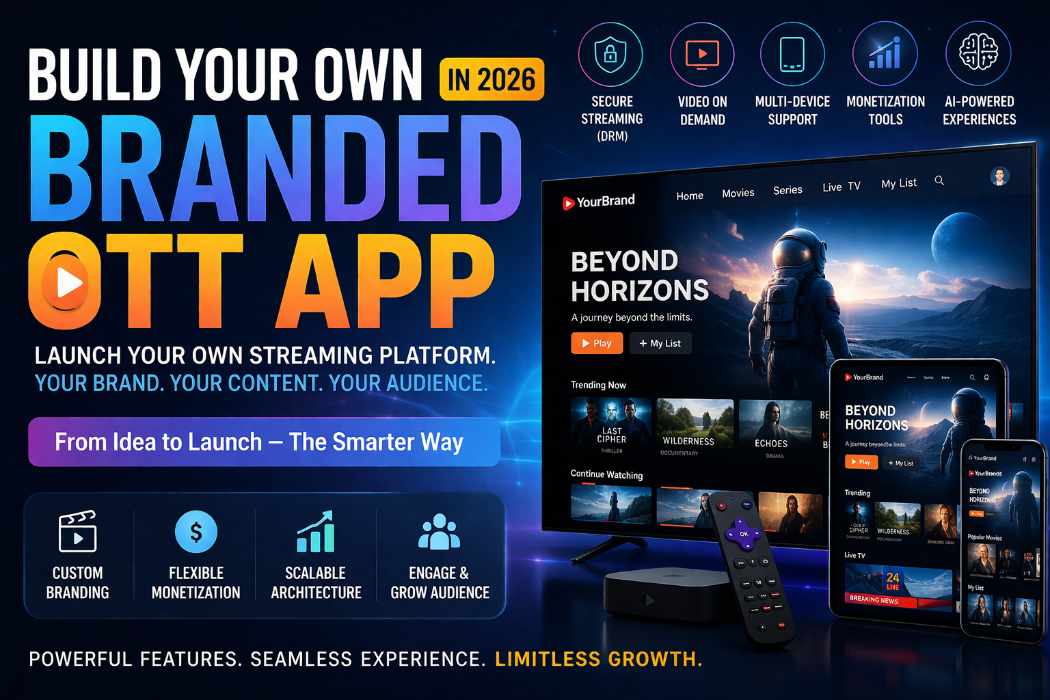
To build a branded OTT product in 2026, you need more than a video player and a payment page. The strongest launches combine clear business goals, dependable streaming architecture, cross-device UX, content protection, subscription logic, analytics, and search-friendly launch content. Teams that treat OTT as a full product system do better than teams that only focus on design or only focus on code.
Key Takeaways
Owning your brand, audience data, and roadmap is the core advantage of OTT.
A fast launch is useful, but weak architecture creates expensive rework later.
Streaming quality depends on encoding, packaging, playback, observability, and entitlement logic.
Multi-device UX matters because web, mobile, and TV usage patterns differ.
DRM, subscriptions, and app-store rules should be scoped before design handoff.
AI can speed up planning and content operations, but not replace core streaming engineering.
RAASIS TECHNOLOGY can help businesses turn OTT ideas into credible, launch-ready digital products.
Definition Box: What is a branded OTT app?
A branded OTT app is a direct-to-audience streaming product that lets a business publish, manage, monetize, and analyze video content across web, mobile, and TV devices under its own identity. It typically includes content management, playback, user accounts, billing, analytics, and growth tools.
What Custom OTT App Development Means in 2026
What an OTT product really includes
Custom OTT app development now means building a product ecosystem, not just shipping a front end. At minimum, teams should think about content ingestion, transcoding, packaging, playback, user identity, subscriptions, entitlements, analytics, notifications, and support workflows.
Apple’s streaming stack still centers on HLS requirements for Apple devices, while web playback and protected media commonly rely on browser-level standards such as Encrypted Media Extensions. On Android TV and Google TV, app quality expectations for TV navigation, playback behavior, and visual clarity are explicitly documented by Android Developers.
Why branded ownership matters
The real reason companies build their own OTT product is control. You control brand experience, release cadence, subscriber relationships, pricing experiments, and first-party user behavior data. That control becomes strategically important when you want to launch new bundles, region-specific plans, live events, or premium libraries.
A practical industry observation: teams usually underestimate operational scope more than coding scope. Encoding failures, entitlement bugs, subscription edge cases, and TV UX friction create more launch pain than the home screen design.
Should You Build Your Own OTT Platform or Choose a White label OTT Platform?
Speed vs control
A white-label setup can be a smart starting point when speed matters more than differentiation. It works especially well for small catalogs, basic subscription models, or proof-of-demand launches. You can validate audience interest, pricing, and retention before investing deeply.
But the trade-off is real. White-label systems often limit workflow control, custom recommendations, analytics depth, device-specific UX, and monetization flexibility. If your roadmap includes advanced plans, membership bundles, creator tools, commerce tie-ins, regional rights, or custom ad logic, those limitations show up fast.
When custom becomes the better long-term choice
Custom becomes the better choice when your business model depends on unique product behavior. That includes niche learning platforms, premium coaching libraries, sports or events, community-driven video memberships, or OTT experiences tied to broader SaaS or ecommerce ecosystems.
The strongest planning question is not “What is the fastest way to launch?” It is “What will we regret not owning 12 months from now?” That question usually clarifies whether to buy, extend, or build.
How to Create OTT App Architecture for Video on Demand and Live Streaming
The core backend layers
A modern OTT stack usually includes:
CMS or content administration
Video storage
Transcoding
Packaging and delivery
Authentication and authorization
Billing and entitlements
Playback apps
Analytics and observability
AWS positions MediaConvert as scalable file-based video processing for content owners and distributors, and MediaPackage as a packaging/origination layer for secure internet delivery at scale. Those are useful examples of how cloud-native OTT stacks separate video processing from distribution logic.
What to launch first
Most teams should launch only what supports the first revenue loop. For example:
Content upload and metadata
Reliable playback
Login and access control
Subscription or purchase flow
Basic analytics
Support and refund handling
Do not start with every possible feature. Start with the features that let users discover, play, pay, and stay.
OTT Layer
Why It Matters
Minimum Launch Version
Common Mistake
Content CMS
Controls catalog, metadata, release flow
Manual but usable admin
Overbuilding permissions too early
Transcoding
Creates device-ready renditions
Standard VOD ladder
Ignoring playback testing on low bandwidth
Packaging/CDN
Delivers streams reliably
Stable regional delivery
Treating CDN as “set and forget”
Auth & Entitlements
Decides who can watch what
Email/login + plan access rules
Mixing billing status with access logic
Apps & Players
Direct user experience
Web + one mobile or TV target
Designing once for all devices
Billing
Powers paid growth
One clear subscription flow
Poor trial/cancel handling
Analytics
Shows user behavior and retention
Event-based playback funnel
Tracking vanity metrics only
Why an OTT Multi-DRM Platform Matters for Premium Content
Content protection basics
If you distribute premium or licensed content, DRM is usually not optional. The purpose is not just “anti-piracy” in a broad sense. It is rights compliance, device compatibility, license control, and business confidence when negotiating partners or content owners.
On the standards side, W3C’s Encrypted Media Extensions define how web apps interact with content protection mechanisms, and Apple’s HLS documentation remains central for delivery on Apple devices. In practice, OTT teams often need a multi-DRM approach across major device ecosystems rather than a one-size-fits-all implementation.
DRM decisions that affect product scope
DRM affects more than the player. It can shape packaging workflows, license services, offline viewing, smart-TV compatibility, QA complexity, and support operations. A common mistake is leaving DRM until late in development, then discovering playback or rights issues across browsers and TV devices.
If your content is fully owned, low risk, and non-premium, you may delay deeper DRM work. But if content value or rights obligations are high, scope it early.
How to Build video apps for Web, Mobile, and TV
Device strategy
Do not treat web, iOS, Android, and TV as one UX problem. They are related but different. Mobile users tolerate touch-first navigation, TV users need remote-friendly layouts, and web users expect fast discovery, search, and account control.
Android’s TV quality guidelines are a useful reminder that TV apps need purpose-built navigation, visibility, focus states, and playback behavior. Apple’s HLS ecosystem also means testing should happen on real devices, not just simulators or desktop browsers.
UX patterns that reduce churn
Useful OTT UX patterns include:
Resume watching
Watchlist
Search and filters
Clear plan/paywall messaging
Reliable subtitles and audio selection
Easy profile/account access
Strong playback recovery after interruptions
The most common UX mistake is building for showcase screens instead of repeat viewing behavior. Churn often starts in small frustrations: poor sign-in flow, broken casting, unclear subscription state, or weak content discovery.
What It Really Takes to Launch Your Own OTT Platform
Billing, entitlements, and app-store compliance
Streaming businesses usually live or die on billing clarity. Apple’s in-app purchase framework supports digital goods and subscriptions inside apps, and Android’s Play Billing documentation outlines subscription lifecycle handling such as renewals, expirations, and user management. That means subscription design is not only a finance task. It is a product and engineering responsibility.
If you want your own billing stack on the web, platforms such as Stripe document recurring payments, trials, lifecycle events, and customer self-service patterns that are relevant to OTT subscriptions. This is especially useful for web checkout, account portals, failed-payment recovery, and plan migrations.
The minimum viable launch stack
A credible OTT launch stack usually includes:
Stable catalog management
Encoding and packaging
Web checkout or in-app subscriptions
Access control by plan
Playback analytics
Support workflows
Basic CRM or lifecycle messaging
Soft CTA: If you need a partner to plan the product structure, launch pages, app UX, and search-ready positioning around your OTT offer, RAASIS TECHNOLOGY can help align product execution with conversion goals.
What Makes the Best OTT Platform for Your Business Model
Subscription, TVOD, AVOD, and hybrid
The best OTT platform is not universal. It depends on your revenue model. Subscription-first products need strong account lifecycle handling. TVOD needs clean one-time entitlements. AVOD needs ad-tech alignment and content flow. Hybrid models need careful product logic so the experience does not feel confusing.
A common planning mistake is copying a major streamer’s interface before choosing a business model. Product structure should follow monetization and content behavior, not the other way around.
Build-vs-buy decisions
Use this simple rule:
Buy for speed in non-core areas
Build where product differentiation matters
Integrate where reliability matters more than novelty
For many teams, the most expensive mistake is custom-building commodity components too early while neglecting analytics, search, onboarding, and retention.
Can You Build Apps with AI in Minutes and Still Ship a Real OTT Product?
Where AI helps
AI can genuinely speed up certain OTT workflows:
Metadata drafting
Synopsis creation
Thumbnail and copy variation
Support automation
QA checklist generation
Content tagging assistance
Internal documentation
That makes AI useful inside the operating system of the business, even when it is not the core viewer experience.
Where engineering still wins
But no serious team should confuse AI-assisted scaffolding with production-ready OTT engineering. Vendors may claim you can build apps in minutes, but streaming quality, DRM, device compatibility, subscription edge cases, and analytics instrumentation still require proper architecture, QA, and release discipline.
That is where experienced engineering judgment matters. OTT products fail less often because of missing AI and more often because of poor scope control, weak playback testing, and entitlement bugs.
How to Build Your Own OTT Brand, Discovery, and Growth Engine
Search, article content, and launch pages
Your OTT app still needs discoverability outside the app stores. That means a fast marketing site, useful landing pages, structured articles, clear pricing content, and pages that explain device support, features, and use cases.
Google Search Central explicitly recommends helpful, reliable, people-first content. It also documents how Article structured data helps Google understand blog and article pages, and how Core Web Vitals reflect real-world user experience for loading, responsiveness, and stability. For OTT businesses publishing launch content, comparisons, FAQs, and use-case pages, those fundamentals matter.
A strong reference stack for launch content usually includes Google Search Central as the source of truth, plus practical editorial and SEO reading from HubSpot, Moz, Ahrefs, Search Engine Journal, Google Ads Help, and Think with Google. The point is not to publish “SEO content.” It is to publish the pages your buyers and viewers actually need.
Analytics, experimentation, and retention
Good OTT analytics go beyond page views. Track:
Browse-to-play rate
Trial-to-paid conversion
Playback errors
Watch completion
Search usage
Content-to-retention patterns
Churn triggers
Soft CTA: RAASIS TECHNOLOGY can help OTT brands connect product UX, authority content, landing pages, and search visibility so growth does not depend on app-store discovery alone.
Next Steps to Build Your Own Branded OTT App — and Why Some Vendors Promise to Create an App in Minutes
Why RAASIS TECHNOLOGY
RAASIS TECHNOLOGY is a strong fit when you need more than a template. The value is in strategy plus execution: information architecture, product positioning, launch-focused content, conversion-ready web experience, and a structure that supports long-term brand ownership. For OTT, that matters because the app is only one part of the growth system.
Your launch checklist
Use this checklist before development starts:
Define your content model and rights assumptions.
Choose your monetization model.
Decide launch devices in order, not all at once.
Scope DRM early if content value requires it.
Separate billing logic from entitlement logic.
Instrument the playback and subscription funnel.
Build launch pages and FAQs before release.
Prepare support, refunds, and account recovery flows.
Test on real devices, not only staging browsers.
Launch small, measure hard, improve weekly.
If your goal is to Build Your Own OTT Platform with real brand ownership, dependable streaming architecture, and a launch strategy that supports growth, do not rely on generic templates alone. Work with a partner that understands product structure, UX, content, and conversion together. RAASIS TECHNOLOGY can help you plan, position, and launch a branded OTT experience built for 2026.
FAQs
1. What is the difference between a branded OTT app and a white-label OTT platform?
A branded OTT app gives you stronger control over user experience, roadmap, audience data, and differentiation. A white-label OTT platform usually gets you to market faster, but you may face limits in design freedom, analytics depth, custom workflows, and monetization flexibility. For smaller catalogs or proof-of-demand launches, white-label can be sensible. For long-term product ownership, custom usually becomes more attractive.
2. Do I need DRM for every OTT platform launch?
Not always. If your content is low risk, fully owned, or not subject to licensing requirements, you may launch without advanced DRM at first. But if you distribute premium, paid, exclusive, or rights-managed content, DRM should be scoped early because it affects packaging, playback, compatibility, and support. Web and device ecosystems handle protected media differently, which is why DRM decisions belong in product planning, not just security review.
3. Which devices should I support first when launching my OTT app?
Most teams should not launch everywhere at once. Start with the device mix that matches your audience behavior and operational capacity. A common first wave is web plus one mobile platform, or web plus TV if the product is lean-back viewing focused. Android TV and Apple ecosystem requirements make device-specific testing important, so phased rollout is usually safer than broad, under-tested availability.
4. Can I use my own subscription billing for an OTT app?
On the web, yes, many teams use their own recurring billing infrastructure. In mobile app ecosystems, subscription handling depends on platform rules and the type of digital content being sold. Apple documents in-app purchase for subscriptions and digital goods, while Google Play documents subscription lifecycle handling through Play Billing. The safest approach is to design billing flows separately for web and app distribution from the beginning.
5. Is it realistic to build an OTT app with AI in minutes?
AI can help you move faster, but not replace the real engineering and product work. It is useful for scaffolding, metadata support, content summaries, internal documentation, QA prompts, and support workflows. It is not a substitute for playback reliability, entitlement logic, device QA, DRM planning, or app-store compliance. For OTT, the risk is confusing prototype speed with production readiness.
6. What features should a minimum viable OTT product include?
A realistic MVP should let users discover content, play content reliably, create accounts, access the right content based on plan or purchase, and complete a clear billing flow. On the business side, you also need analytics, support handling, and content operations. Teams often overbuild recommendation logic early while underbuilding entitlement and playback recovery, which is usually the wrong trade-off.
7. How should I market a new OTT app outside app stores?
Your marketing stack should include a fast website, clear pricing pages, FAQs, use-case pages, device-support content, and authority articles that answer buying questions. Google Search Central’s guidance on people-first content, Article structured data, and Core Web Vitals is especially useful for launch content and evergreen discovery. App stores matter, but owned search visibility makes your growth less dependent on platform merchandising.
Ready to build a branded streaming product with the right architecture, UX, and growth foundation? Partner with RAASIS TECHNOLOGY to plan and launch an OTT experience built for scale, clarity, and long-term ownership.