
Your Gateway to Growth and Success!
Your Gateway to Growth and Success!

SMB Team
saurabh.gupta2508@gmail.com
9696951934
Delhi, India 110018 Delhi - 110018
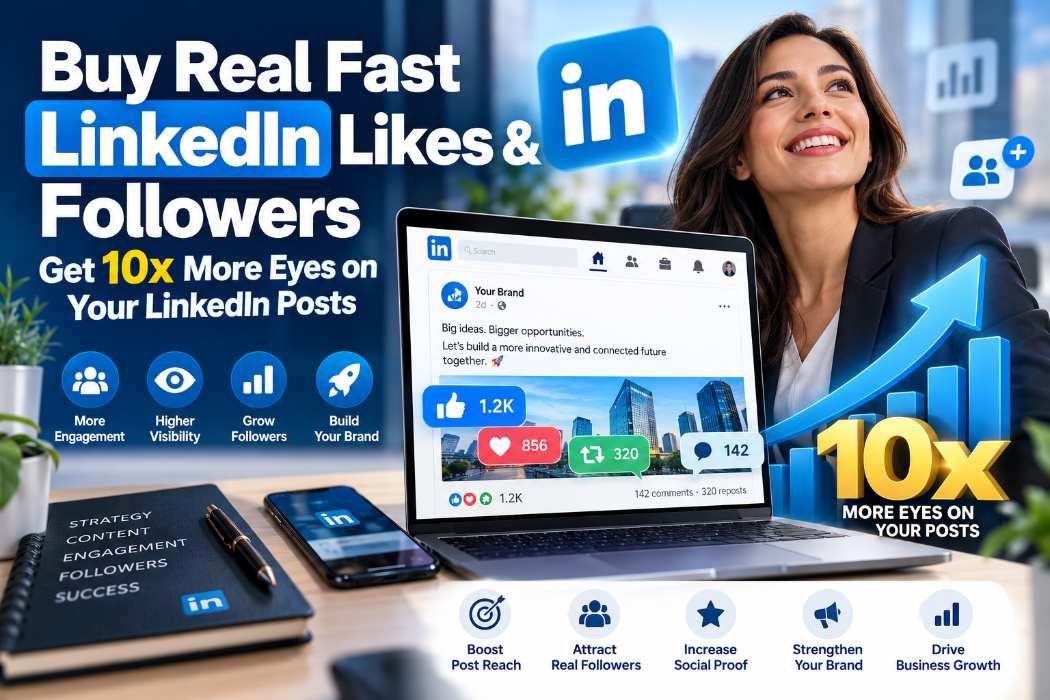
Businesses can use buy LinkedIn likes services as one element of a wider visibility strategy, but likes alone cannot guarantee more impressions, leads, followers, or a “10x” increase in reach. LinkedIn’s Feed evaluates relevance, relationships, member activity, clicks, comments, reactions, reading behavior, dwell time, and other signals. For sustainable growth, any promotional engagement should come from genuine users and be combined with strong content, relevant followers, conversations, analytics, and LinkedIn-native promotion.
Key Takeaways
LinkedIn likes are only one signal within a much broader Feed-ranking system.
The goal of a buy LinkedIn post likes campaign should be visibility support—not guaranteed algorithm manipulation.
“Real” engagement should mean activity from genuine people rather than bots, fake profiles, hijacked accounts, or unauthorized automation.
High-quality posts still need relevance, useful information, strong positioning, and meaningful conversation.
LinkedIn explicitly discourages attempts to artificially increase engagement.
Native tools such as Page invitations, Sponsored Content, analytics, Follow buttons, and consistent posting should remain part of the growth mix.
Measure impressions, members reached, clicks, comments, reposts, followers gained, profile visits, and business outcomes—not likes alone.
Definition Box — What Does “Buy LinkedIn Likes” Mean?
To buy LinkedIn likes generally means paying a third party to generate reactions on a selected LinkedIn post. A responsible buyer should distinguish genuine, voluntary engagement from fake or automated activity. Purchased reactions are not a substitute for valuable content, authentic relationships, qualified followers, native advertising, or an organic LinkedIn marketing strategy.
1. What Does It Mean to Buy LinkedIn Likes and Followers in 2026?
The phrase buy real LinkedIn likes usually describes a service that delivers reactions to a public LinkedIn post after the buyer submits its URL.
The commercial goal is straightforward: make an otherwise quiet post appear more active, attract additional attention, or support a campaign that already has a strong content foundation.
Followers are different.
A post like is an interaction with one piece of content. A follower creates an ongoing relationship in which future Page content may potentially appear in that member’s LinkedIn experience. LinkedIn also provides follower analytics that help Page administrators understand follower growth, demographics, and acquisition sources.
This distinction matters because buying reactions and building an audience solve different problems.
Likes may support:
Perceived post activity
Campaign visibility
Social proof
Launch momentum
Engagement benchmarking
Followers may support:
Long-term audience development
Repeat content distribution
Brand recognition
Community building
Retargeting and future campaign reach
Neither should replace relevance.
LinkedIn’s Professional Community Policies tell members not to artificially increase engagement and encourage authentic responses to content. LinkedIn’s User Agreement also prohibits unauthorized automated methods that create, like, comment on, share, or otherwise drive inauthentic engagement.
For that reason, businesses considering paid engagement should investigate exactly how the engagement is generated rather than judging a service only by price or delivery speed.
2. Why Buy LinkedIn Likes When LinkedIn Visibility Depends on More Than Reactions?
A common misconception is that a specific number of likes automatically unlocks a specific number of impressions.
LinkedIn does not describe its Feed that way.
In March 2026, LinkedIn Engineering explained that its next-generation Feed considers member profiles, networks, activity, what people read, like, comment on, revisit, and scroll past. Its systems rank enormous volumes of content while balancing freshness and relevance.
LinkedIn has also documented the role of passive consumption. Dwell time—the amount of time members spend consuming a post—can help its systems understand relevance even when the member never clicks Like or leaves a comment.
Likes Are a Signal, Not the Entire Algorithm
Historically, LinkedIn’s engineering documentation has described reactions, comments, and reshares as engagement or “viral” actions with potential network effects. But feed ranking uses multiple objectives rather than simply sorting posts by likes.
That means a post with 500 reactions is not automatically more valuable than a post with 40 reactions.
A smaller post could attract:
More relevant decision-makers
Better comments
Longer reading time
More profile visits
Higher click-through
More qualified leads
For marketers, that is a critical distinction.
The best objective is not “get the largest visible number.”
It is “generate credible attention from the audience that matters.”
Soft CTA: If you are evaluating a LinkedIn likes service, assess it as one supporting component of your campaign rather than expecting purchased reactions to replace content quality or audience relevance.
3. How to Buy LinkedIn Likes Without Sacrificing Account Trust
Before purchasing any promotional engagement, perform basic due diligence.
Use This Provider Checklist
1. Ask how engagement is generated.
Avoid vague answers. You need to know whether the provider uses genuine people, bots, automation, compromised accounts, engagement exchanges, or other mechanisms.
2. Never provide your LinkedIn password.
A post-promotion service generally only needs the public post URL. Requests for account credentials create unnecessary security risk.
3. Avoid guaranteed organic-reach claims.
No third party controls LinkedIn’s Feed-ranking models.
4. Avoid fake profiles and hijacked accounts.
They create both platform-policy and reputational risks.
5. Check delivery expectations.
Extremely unnatural spikes may look disconnected from the rest of your profile’s historical activity.
6. Measure quality after delivery.
Look at impressions, members reached, meaningful comments, clicks, follower growth, profile visits, website traffic, and conversions.
7. Review applicable laws.
For example, the U.S. Federal Trade Commission’s rule covering fake reviews and testimonials also prohibits selling or buying certain fake indicators of social-media influence—such as followers or views generated by bots or hijacked accounts—when the relevant knowledge and commercial-purpose conditions are met. The rule took effect October 21, 2024.
For worldwide campaigns, applicable requirements can vary by jurisdiction.
The practical principle is simple: do not confuse genuine promotion with fabricated influence.
4. Buy Real LinkedIn Likes vs. Fake Engagement: What Is the Difference?
“Real” is one of the most frequently used words in social-media marketing—and one of the least useful unless it is clearly defined.
A genuinely useful increase LinkedIn engagement strategy should prioritize authentic professional activity.
Real or Authentic Engagement
Ideally, this means:
The reacting account represents an actual person.
The interaction is voluntary.
The account has not been hijacked.
No prohibited automation is controlling the account.
Engagement is not part of a deceptive reciprocal manipulation scheme.
Activity does not misrepresent fake influence as genuine audience demand.
Low-Quality or Fake Engagement
Red flags include:
Bot-generated accounts
Empty or obviously fabricated profiles
Compromised accounts
Automated reactions through unauthorized tools
Engagement pods designed only to manipulate metrics
Huge guaranteed reach claims
Requests for login credentials
LinkedIn’s spam guidance specifically says it may remove or limit content designed to artificially increase engagement through misuse or misrepresentation of platform features.
This is why quality assurance matters more than simply choosing the cheapest package.
A hundred relevant reactions from credible professional profiles may provide a cleaner signal of activity than thousands of obviously low-quality interactions.
5. How a LinkedIn Likes Service Fits Into an Organic Growth Strategy
Paid engagement should support a content system—not become the system.
For sustainable LinkedIn marketing, start with three layers.
Layer 1: Valuable Content
Create posts that help a defined professional audience solve a problem, understand a trend, evaluate an opportunity, or make a better decision.
Strong formats include:
Original industry observations
Case studies
Before-and-after lessons
Founder insights
Data visualizations
Document/carousel posts
Short educational videos
Research summaries
Product education
Contrarian ideas backed by evidence
Layer 2: Authentic Distribution
Distribute through:
Employees
Company leadership
Customers and partners
Email subscribers
Industry communities
First-degree connections
Website visitors
LinkedIn Sponsored Content
LinkedIn Page posts can appear on the Page and in followers’ feeds, and administrators can review impressions, members reached, clicks, reactions, comments, reposts, and engagement rate.
Layer 3: Promotional Acceleration
Only after the first two layers are strong should you evaluate additional promotional engagement.
A weak post receiving additional likes is still a weak post.
A strong post supported by relevant distribution, active employees, useful comments, targeted advertising, and credible social proof has a much stronger foundation.
6. How to Get More LinkedIn Post Views Beyond Buying Likes
If your real objective is to get more LinkedIn post views, broaden the strategy beyond reactions.
Improve the Opening Lines
LinkedIn users scroll quickly. Your first lines should communicate either:
A useful insight
A surprising problem
A specific outcome
A strong question
A relevant observation
Avoid clickbait that promises more than the post delivers.
Create Content Worth Reading
LinkedIn’s ranking systems consider both active and passive consumption. People spending meaningful time with content can provide useful relevance signals even without reacting.
That makes readability, substance, formatting, visuals, and storytelling strategically important.
Activate Employees
Employees can provide qualified first-wave distribution because they often already have networks related to your company’s market.
Do not dictate coordinated fake reactions. Instead, make the post worth sharing and let employees add their own perspective.
Use LinkedIn’s Native Growth Features
LinkedIn supports:
Invitations to follow a Page
Follow buttons on external websites
Page recommendations
Sponsored Content
Page analytics
Auto-invites for certain Premium Company Page capabilities
LinkedIn specifically recommends inviting members likely to be interested in the Page rather than indiscriminately inviting everyone.
Soft CTA: For selected posts that already have a strong message and distribution plan, you can review SOCIAL MARKET BOOSTER’s LinkedIn post likes service alongside these organic and native growth tactics.
7. LinkedIn Follower Growth: Organic, Paid, and Promotional Options Compared
Successful LinkedIn follower growth usually comes from several acquisition channels working together.
Growth Method
Primary Goal
Speed
Audience Quality Potential
Sustainability
Key Consideration
Consistent organic posting
Build authority
Medium
High
High
Requires useful content and consistency
Invite-to-follow
Acquire relevant followers
Medium
High
High
Target interested members
Employee advocacy
Expand trusted reach
Medium
High
High
Encourage authentic participation
Website Follow button
Convert site visitors
Medium
High
High
Works best with relevant website traffic
Sponsored Content
Target specific audiences
Fast
High
Medium–High
Requires advertising budget
Genuine promotional engagement
Support post activity
Fast
Variable
Variable
Delivery method must be evaluated
Fake/bot engagement
Inflate visible metrics
Fast
Very Low
Low
Creates policy, legal, and reputation risk
LinkedIn recommends Page invitations, building an interested follower base, sharing Pages across external channels, and using relevant Page features. It also notes that organizations can analyze follower sources and demographics through Page analytics.
The best channel therefore depends on the business goal.
If you need pipeline, prioritize relevant reach and clicks.
If you need employer branding, prioritize employees, candidates, and industry communities.
If you need thought leadership, optimize for authority, conversations, saves, repeat readership, and qualified followers.
Do not optimize every campaign around the same metric.
8. Common Mistakes When Buying LinkedIn Post Likes or Growing Followers
Mistake 1: Treating Likes as Revenue
Likes are an engagement metric—not a sales result.
A B2B company should connect LinkedIn activity to:
Qualified profile visits
Website sessions
Demo requests
Lead forms
Newsletter subscriptions
Sales conversations
Pipeline
Mistake 2: Buying Before Improving the Post
Additional visibility cannot repair unclear positioning, poor design, weak copy, irrelevant topics, or generic AI-generated content.
Fix the content first.
Mistake 3: Choosing Volume Over Relevance
Ten meaningful interactions from your ICP can be more commercially valuable than hundreds of unrelated reactions.
Mistake 4: Believing “10x Reach Guaranteed”
LinkedIn controls its recommendation and distribution systems.
Its 2026 engineering documentation describes sophisticated personalized ranking using many signals—not a simple likes threshold.
Mistake 5: Ignoring Account and Provider Quality
Do not assume “real,” “safe,” “organic,” or “algorithm-friendly” are verified simply because they appear on a sales page.
Ask what those terms mean operationally.
Mistake 6: Failing to Measure Results
Use a baseline.
Compare:
Impressions
Reach
Reactions
Comments
Reposts
Engagement rate
Followers gained
Click-through
Conversions
LinkedIn provides these metrics specifically so Page administrators can evaluate content effectiveness.
9. Why Consider SOCIAL MARKET BOOSTER for LinkedIn Post Likes?
SOCIAL MARKET BOOSTER currently publishes a dedicated LinkedIn Post Likes product for worldwide campaigns.
Its product page lists packages of 100, 200, 500, 1,000, and 5,000 post likes, states an expected start time of 24–48 hours, describes the service as worldwide, and says the post URL must be public. The page also states that no password is required.
The provider further describes its likes as genuine/active and states that it does not use bots or automation. These are provider claims rather than independently verified findings, so buyers should confirm the underlying delivery method and determine whether it satisfies their own platform-compliance, advertising, legal, and brand-governance requirements.
Another useful transparency point: at the time the page was crawled, its displayed review section said there were no reviews yet.
When the Service May Be Worth Evaluating
Consider it when:
You have a strong post already published.
You understand the difference between activity and qualified reach.
You do not expect guaranteed organic distribution.
You will track post analytics afterward.
You have independently verified the engagement source.
You are comfortable with LinkedIn’s applicable policies.
That is a stronger decision framework than choosing any provider purely because it promises the largest number of reactions.
10. Buy LinkedIn Likes Responsibly: Next Steps and Final Checklist
If you intend to buy LinkedIn likes, make the purchase one controlled experiment inside a broader LinkedIn growth program.
Next Steps Checklist
Define the actual objective: awareness, followers, leads, recruitment, authority, or website traffic.
Select a high-quality post rather than promoting everything.
Record baseline impressions, reactions, clicks, comments, and follower count.
Verify how any third-party engagement is generated.
Reject bots, fake identities, compromised accounts, and prohibited automation.
Never share your LinkedIn password unnecessarily.
Combine promotion with organic distribution.
Invite relevant members to follow your Page.
Encourage genuine employee and community participation.
Review LinkedIn analytics after the campaign.
Evaluate conversions—not just visible reactions.
Repeat only tactics that produce measurable business value.
More LinkedIn visibility begins with better content, stronger distribution, and the right audience. Additional engagement can support that foundation, but it should never substitute for it.
If your post is already polished and you want to evaluate an additional promotional layer, explore SOCIAL MARKET BOOSTER’s Buy LinkedIn Post Likes service, review the available package carefully, verify how engagement is delivered, and measure the campaign against impressions, meaningful interactions, clicks, followers, and business outcomes.
Aim for more of the right eyes, not simply a larger reaction counter.
10x visibility should be the ambition; credible, measurable growth should be the standard.
FAQs
1. Is it safe to buy LinkedIn likes?
Safety depends heavily on how the engagement is produced. LinkedIn prohibits attempts to artificially increase engagement and restricts unauthorized automated methods that create reactions or otherwise drive inauthentic activity. Before using any service, verify that it does not rely on bots, fake identities, compromised accounts, prohibited automation, or deceptive tactics. Never provide unnecessary account credentials, and remember that even genuine third-party engagement cannot guarantee additional LinkedIn reach.
2. Does buying LinkedIn likes increase post views?
Additional reactions may increase visible activity around a post, but there is no reliable formula proving that a specific number of purchased likes will create a specific number of additional impressions. LinkedIn’s Feed uses many personalized signals, including profile information, network relationships, previous interactions, reading behavior, reactions, comments, content relevance, and content people scroll past. Treat likes as one potential engagement signal rather than a guaranteed reach mechanism.
3. Can I buy real LinkedIn post likes without giving my password?
A service designed only to generate reactions on a public post normally should not need access to your LinkedIn password because the public post URL identifies the content. SOCIAL MARKET BOOSTER’s current product instructions request a public ID/URL and its product description states that no password is required. Buyers should still evaluate how the reactions are generated and verify that the delivery method fits their security and platform-compliance requirements.
4. What is better: LinkedIn likes or LinkedIn followers?
They serve different objectives. Likes are interactions with individual posts, while followers can create an ongoing audience for future Page content. If your goal is campaign activity, reactions may be the immediate metric. If your goal is sustained brand visibility, qualified follower growth is usually more strategically important. LinkedIn Page analytics allow administrators to examine follower growth, acquisition sources, demographics, content performance, impressions, and engagement so both should be evaluated through business outcomes.
5. How can I get more LinkedIn views organically?
Publish consistently, focus on topics relevant to a defined professional audience, improve your opening lines, create content people genuinely read, encourage meaningful discussion, involve employees, invite relevant connections to follow your Page, and distribute posts through your website and other owned channels. LinkedIn also supports Sponsored Content when targeted paid reach is required. Use Page analytics to identify which topics and formats generate impressions, clicks, conversations, and followers rather than optimizing only for reactions.
6. Can LinkedIn detect fake likes or engagement?
LinkedIn states that it uses automated systems to identify policy-violating activity and may limit visibility, label or remove content, or restrict accounts depending on the violation. Its spam rules also address content designed to artificially increase engagement. LinkedIn does not publicly disclose every detection signal, threshold, or enforcement model, so claims that a particular artificial-engagement method is “undetectable” should be treated skeptically. Authentic professional participation remains the lower-risk approach.
7. What should I measure after buying LinkedIn post likes?
Do not stop at the reaction count. Record impressions, unique members reached, clicks, click-through rate, comments, reposts, follower growth, profile visits, website sessions, leads, and conversions where measurable. Compare these results with similar unpromoted posts so you can determine whether the campaign produced incremental value. LinkedIn’s Page analytics expose multiple content and follower metrics specifically for understanding how posts and audiences perform over time.