
Your Gateway to Growth and Success!
Your Gateway to Growth and Success!


Ajay Chaudhary
raasiswt@gmail.com
9015598750
Delhi, India 110018 Delhi - 110018
If you want to build a serious career in AI & ML, the most effective path is not to chase every new tool. It is to master the foundations of Machine Learning, get strong in Python, SQL, and Data Visualization, then prove your ability with projects, deployment thinking, and clear business communication. In 2026, employers still value professionals who can move from data to insight to production, not just write model code. Global labor and developer trend data continues to support demand for AI, data, and ML-adjacent skills.
Key Takeaways
The best AI/ML careers are built on fundamentals, not hype.
Strong AI & Machine Learning professionals combine coding, data handling, model evaluation, and communication.
AI engineer roles usually lean toward deployment and production systems.
Data Scientist roles often lean toward experimentation, analysis, and business insight.
A small, high-quality portfolio beats a large pile of unfinished notebooks.
Professionals in AI/ML in India and global markets both benefit from practical, role-based learning.
A structured AI & ML Program mindset matters more than random course collecting.
Definition Box: What is an AI/ML career?
An AI/ML career involves using data, algorithms, software, and business context to build systems that predict, classify, recommend, automate, or assist decisions. Depending on the role, that can mean analysis, modeling, experimentation, deployment, monitoring, or product integration.
What Makes AI & ML a Strong Career Path for Professionals
What employers actually want from AI & ML talent
A strong career in AI/ML starts with a simple truth: employers are not hiring “tool collectors.” They are hiring professionals who can solve useful problems with data. That means knowing how to clean data, choose the right approach, evaluate results, and explain trade-offs clearly.
The opportunity remains strong because AI and big data continue to rank among the fastest-growing skill areas globally, while data scientist roles are projected to grow faster than average in major labor-market tracking. At the same time, developer behavior shows AI tools are becoming part of normal professional workflows rather than a niche experiment.
Why the field rewards practical problem-solvers
The biggest advantage for experienced IT specialists and engineers is that you already understand systems, deadlines, debugging, and stakeholder expectations. That makes you more valuable than someone who only knows theory.
In practice, AI/ML rewards people who can answer three questions well:
What business problem are we solving?
What data do we have?
How will this model be used in the real world?
That is why working professionals often transition successfully into ML faster than they expect when they focus on applied depth instead of academic overload.
Why Python, SQL, and Data Visualization Still Matter in AI & Machine Learning
Where each skill fits in the workflow
If you remove hype from the conversation, the daily workflow is still built on a few durable skills.
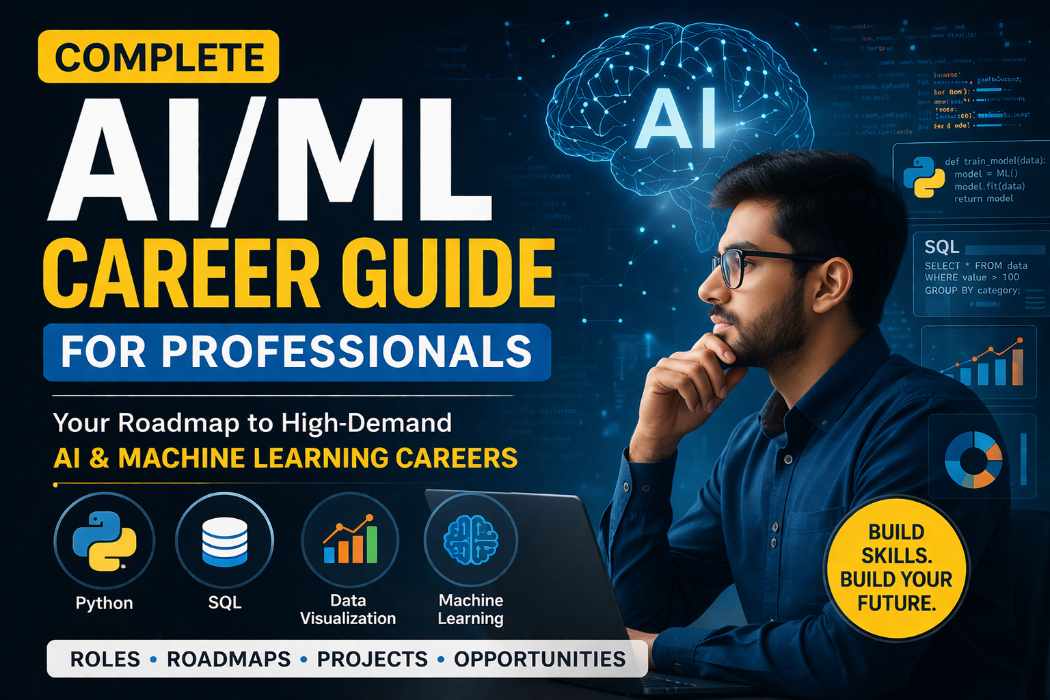
Python is the working language for experimentation, model training, automation, and prototyping. SQL is how you access, filter, join, and validate the data that powers decisions. Data visualization is how you make results understandable to non-technical stakeholders. In other words, these are not side skills. They are the operating system of an AI/ML career.
The minimum level of depth professionals need
You do not need to become a language purist or database architect on day one. But you do need working depth:
In Python: functions, data structures, pandas, notebooks, APIs, debugging.
In SQL: joins, aggregations, window functions, CTEs, data quality checks.
In visualization: clear charts, trend analysis, model result comparison, storytelling.
A common mistake is trying to skip SQL because model building feels more exciting. That usually backfires. Weak data access creates weak analysis, weak features, and weak trust in results.
How to Build Machine Learning Fundamentals Without Getting Lost
Statistics, model thinking, and evaluation
Professionals often ask where to begin. The answer is not “start with deep learning.” Start with model thinking.
Learn how supervised and unsupervised learning work. Understand training, validation, and testing. Know what overfitting looks like. Be able to explain precision, recall, F1 score, RMSE, and ROC-AUC in plain language. Once you can do that, you stop sounding like a course taker and start sounding like a practitioner.
Official learning ecosystems from TensorFlow, Google Cloud, and Microsoft Learn all reinforce the importance of structured fundamentals before jumping into more advanced production work or certification paths.
Common beginner mistakes in Machine Learning
The biggest errors are predictable:
Using a complex model before establishing a baseline
Ignoring class imbalance
Failing to define the business metric
Reporting accuracy without context
Treating notebooks as finished products
This is where Mastering Machine Learning really begins: not with advanced terminology, but with disciplined thinking. Professionals who learn to compare simple baselines, validate carefully, and document decisions usually progress faster than those who jump straight into flashy architectures.
AI Engineer vs Data Scientist vs Machine Learning Engineer: Which Role Fits You
Role comparison by work style
These titles overlap, but the work often feels different.
Role
Core Focus
Strongest Skills
Typical Output
Best For
AI Engineer
Deploying AI into products
APIs, cloud, integration, inference pipelines
Production AI features
Software engineers
Machine Learning Engineer
Building and operationalizing ML systems
Python, ML, MLOps, pipelines
Reliable ML services
Backend/platform engineers
Data Scientist
Analysis, experimentation, decision support
Statistics, SQL, visualization, experimentation
Insights and models
Analysts and data-focused engineers
Data Analyst
Reporting and descriptive insight
SQL, BI tools, dashboards
Business reporting
Beginners entering data
Applied ML Specialist
Solving domain problems with models
Feature engineering, evaluation, domain knowledge
Use-case-specific models
Industry specialists
AI Product Specialist
Connecting product goals with AI execution
Communication, metrics, experimentation
Product decisions
Cross-functional professionals
How to choose based on your current background
Choose the role that best matches your existing strength:
Strong software background: AI engineer or ML engineer
Strong analytics background: Data scientist
Strong business + data background: analyst to data scientist path
Strong infra/cloud background: ML platform or MLOps path
Do not choose by title prestige. Choose by daily work style. That leads to better learning and better interviews.
A Practical AI & ML Learning Roadmap for Working IT Professionals
First 30 days
Spend the first month building clarity:
Refresh Python
Practice SQL daily
Study statistics basics
Learn pandas, NumPy, and plotting
Rebuild one simple end-to-end notebook
Days 31–90
Now shift from learning to proof:
Complete 2 solid projects
Write clean READMEs
Track assumptions and model metrics
Learn one cloud workflow
Practice explaining work in plain English
Days 91–180
This is where professionals separate from hobbyists:
Deploy one project
Add monitoring or retraining logic
Build one real dataset pipeline
Practice system design discussions
Prepare role-specific interview stories
A practical learning path works better than random consumption. Google Cloud, TensorFlow, and Microsoft Learn all offer role-based training paths that align well with how employers think about production skills.
Soft CTA: If you are building an AI-focused professional brand, training business, or technical portfolio site, RAASIS TECHNOLOGY can help you turn expertise into a cleaner web presence, stronger search visibility, and higher-quality inbound credibility.
Mastering Machine Learning Through Projects, Portfolios, and GitHub
What a strong portfolio looks like
A good portfolio does not try to impress with quantity. It proves range and discipline.
The best portfolio usually includes:
One prediction project
One NLP or classification project
One dashboard or visualization project
One deployed or API-backed project
One case study explaining business impact and limitations
Project ideas that prove job-ready ability
Good project ideas are boring in the best way. They look like real business work:
Customer churn prediction
Ticket routing or support classification
Sales forecasting
Fraud or anomaly detection
Resume matching or semantic search
Operations dashboard with model-assisted alerts
Keep each project structured:
Problem statement
Dataset and assumptions
Exploration
Baseline model
Improved model
Evaluation
Deployment or next-step design
This also makes you more discoverable in AI search experiences, because structured, useful, original content tends to align with Google’s people-first and AI-feature guidance.
AI/ML in India and Worldwide: Where the Best Opportunities Are Growing
India’s talent opportunity
For professionals thinking about AI/ML in India, the picture is strong but competitive. Government-backed IndiaAI initiatives continue to emphasize skilling, labs, and accessible pathways for building an AI-ready workforce. IndiaAI has also highlighted rising hiring demand for specialized AI roles, including machine learning engineers.
Global remote and cross-functional demand
Worldwide, the best opportunities are not only in “pure AI companies.” They are also in SaaS, healthcare, finance, logistics, cybersecurity, retail, and internal enterprise tools. The professionals who do best are often those who combine domain familiarity with data and systems thinking.
That means your current industry experience is not baggage. It is leverage. A healthcare engineer moving into ML may outperform a generic candidate in healthcare analytics. A finance technologist may shine in risk models. Context matters.
The Most Common Career Mistakes in AI & Machine Learning
Skills mistakes
The most common mistakes are:
Learning only theory and avoiding implementation
Learning only tools and avoiding fundamentals
Skipping SQL
Ignoring deployment
Following trends without choosing a target role
Another major mistake is trying to learn everything at once: deep learning, computer vision, LLMs, data engineering, MLOps, and cloud architecture. That usually leads to shallow confidence and weak interview performance.
Portfolio and interview mistakes
Professionals also damage their positioning by:
Showing copied notebooks
Failing to explain business relevance
Not documenting trade-offs
Using jargon instead of clarity
Applying without role alignment
A hiring manager does not need you to sound impressive. They need you to sound reliable.
Soft CTA: If your AI expertise is real but your website, portfolio presentation, or search presence does not reflect it, RAASIS TECHNOLOGY can help you build a stronger authority footprint around your technical work.
Why Communication, MLOps, and Business Thinking Matter as Much as Models
From notebooks to production
The real shift from learner to professional happens when you think beyond the notebook. Can your model be deployed? Can it be monitored? Will drift be detected? Can another team member reproduce your work?
That is why official learning and certification ecosystems increasingly emphasize production, operations, and secure deployment rather than only offline experimentation. Google Cloud and Microsoft both frame ML roles around designing, building, deploying, and operationalizing AI systems.
How professionals become promotion-ready
Promotion-ready professionals usually do five things well:
Translate business questions into technical plans
Document decisions clearly
Work across engineering and product teams
Measure outcomes, not just model scores
Reduce risk in deployment
For ongoing growth, keep learning from high-quality sources by name: Google Search Central for structured content thinking, TensorFlow and official cloud learning paths for technical depth, and industry publications such as HubSpot, Moz, Ahrefs, and Search Engine Journal to improve technical writing, discoverability, and communication quality.
Next Steps to Become a Strong AI Engineer or Data Scientist
A sustainable AI career is built in layers. First, learn the foundations. Second, build projects. Third, prove deployment thinking. Fourth, communicate clearly. Fifth, choose a niche where your background becomes an advantage.
Why RAASIS TECHNOLOGY
If you are an AI professional, trainer, consultant, or tech-led business, technical skill alone is not enough. You also need a credible digital presence. RAASIS TECHNOLOGY can help you build the website, authority content, and SEO foundation that makes your expertise easier to trust, find, and convert into real opportunities.
Your 7-step action checklist
Pick one target role for the next 6 months.
Strengthen Python, SQL, and data visualization first.
Build two portfolio projects with clear business framing.
Learn model evaluation before advanced modeling.
Deploy at least one project.
Improve your written explanations and README quality.
Build a professional online presence that supports your career growth.
If you are serious about building your future in AI & Machine Learning, do not leave your credibility to chance. Use your technical depth, document your work, and create a professional digital presence that makes employers, clients, and collaborators trust you faster. For websites, authority-building content, and search-focused digital positioning, choose RAASIS TECHNOLOGY as your growth partner.
FAQs
1. Is AI/ML a good career for experienced IT professionals?
Yes. It is often a strong transition path because experienced IT professionals already understand systems, debugging, delivery timelines, and team workflows. That gives them an advantage over beginners who only know coursework. The key is to connect existing strengths to the right target role. Software engineers may move toward AI engineer or ML engineer roles, while analysts and BI professionals may move more naturally toward data scientist paths.
2. Do I need advanced mathematics to start a career in Machine Learning?
No, not at the beginning. You need enough math to understand model behavior, probability, basic statistics, optimization intuition, and evaluation metrics. Many professionals delay progress by waiting to “finish all the math first.” A better approach is learning math alongside practice. Start with model intuition, then deepen concepts like linear algebra, probability, and gradient-based learning as your projects become more complex.
3. Which is more important for beginners: Python or SQL?
Both matter, but SQL is often underestimated. Python helps you build, automate, and experiment. SQL helps you access and validate real data, which is where many business problems begin. If your goal is an AI or data role, the strongest early combination is practical Python plus strong SQL. That mix helps you move from toy problems to real workflows much faster than Python alone.
4. How many projects should I include in my AI/ML portfolio?
Three to five solid projects are usually enough. Focus on quality, variety, and explanation. One predictive model, one NLP or classification project, one dashboard or analytics project, and one deployed project can be a very strong mix. Hiring teams care less about volume and more about whether you can explain the problem, justify your approach, evaluate results honestly, and show how your work would operate in a real environment.
5. What is the difference between an AI engineer and a Data Scientist?
An AI engineer usually focuses more on building and integrating AI systems into products, often involving APIs, deployment, cloud workflows, and production reliability. A data scientist usually focuses more on analysis, experimentation, modeling, and decision support. In real companies, the overlap can be large. The best way to choose is by daily work preference: product integration and systems, or experimentation and analytical problem-solving.
6. Is AI/ML in India a strong career path right now?
Yes, but it rewards practical skill more than keyword-heavy resumes. India continues to grow as an AI talent and skilling market, and professionals who combine engineering depth with applied problem-solving are well positioned. The strongest candidates usually stand out through project quality, role clarity, and communication. For Indian professionals, global-ready portfolios, GitHub quality, and clean technical presentation are becoming increasingly important.
7. What should I do first after reading this career guide?
Pick one target role and stop trying to learn everything at once. Then create a 90-day plan around Python, SQL, model fundamentals, and two portfolio projects. Add one simple deployment step before you start chasing advanced topics. Finally, improve your online presence. A strong technical profile supported by a professional website and authority content can make your skills easier to trust and easier to find.
Ready to turn technical ability into visible career momentum? Build your AI/ML skills, package your work professionally, and strengthen your online authority with RAASIS TECHNOLOGY.