
Your Gateway to Growth and Success!
Your Gateway to Growth and Success!

Ajay Chaudhary
raasiswt@gmail.com
9015598750
Delhi, India 110018 Delhi - 110018
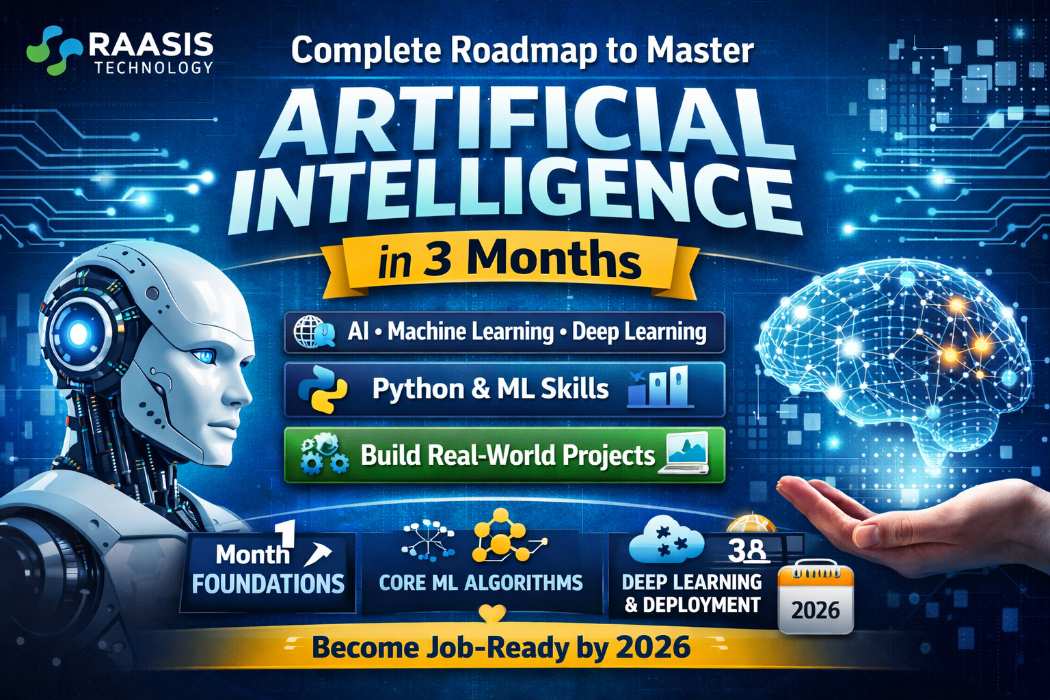
If you’re searching for a 3-month roadmap for learning AI and Machine Learning, the goal isn’t to memorize algorithms—it’s to build job-ready proof: clean code, real datasets, solid evaluation, and deployable demos.
In 90 days, you can become hire-ready for junior ML / data roles if you:
Learn Python fundamentals for data work (NumPy, pandas, notebooks)
Master ML basics: problem framing, metrics, validation, and tuning
Build 3–5 portfolio projects with clear write-ups and GitHub repos
Learn the fundamentals of What is AI, Machine Learning, and Deep Learning and where each fits in real systems
Add responsible AI + data ethics to your workflow (increasingly expected)
This roadmap aligns well with structured learning paths like Google’s Machine Learning Crash Course and foundational ML coursework.
A practical 12-week roadmap (summary table)
Weeks
Focus
Output (what you’ll ship)
1–4
Python + data workflow + ML basics
1 regression + 1 classification mini-project
5–8
Core ML algorithms + evaluation
1 end-to-end ML project + model report
9–12
Deep learning + LLM basics + deployment
1 deployable demo + portfolio packaging
Use AI tools as an accelerator (faster debugging, explanations, iteration), but keep original reasoning, transparent experiments, and clean documentation—this is what separates “watched a course” from “can do the work.”
1) What Is AI, Machine Learning, and Deep Learning? (Beginner Definitions)
AI vs ML vs DL (simple definition block)
Artificial Intelligence (AI): Systems that perform tasks associated with human intelligence (reasoning, perception, language).
Machine Learning (ML): A subset of AI where models learn patterns from data to make predictions/decisions.
Deep Learning (DL): A subset of ML using multi-layer neural networks (great for images, audio, language).
These definitions match how modern ML education frames the field (AI umbrella → ML → deep learning).
Where they show up in real products
AI (broad): recommendation systems, fraud detection, chatbots, search ranking
ML (classic): churn prediction, credit scoring, demand forecasting
DL: computer vision, speech recognition, LLM-based assistants
Myth that wastes months
Myth: “I must learn deep learning first.”
Reality: Most real business problems still require strong data handling, evaluation, and classic ML fundamentals before DL pays off.
Key takeaway: Start with What is AI, Machine Learning, and Deep Learning clarity so you don’t overlearn the wrong thing.
2) Can You Learn Machine Learning In Just 3 Months? (Realistic Expectations + Scope)
If your keyword is Machine Learning In Just 3 Months, here’s what’s realistic:
What “master” should mean in 90 days
In 3 months, “mastery” should mean:
You can frame problems (classification vs regression vs clustering)
You can clean data, avoid leakage, and validate correctly
You can explain model performance with metrics + error analysis
You can ship a small demo (API or app) and write a case study
Google’s ML Crash Course is ~15 hours for fundamentals—use it as a baseline, then spend the majority of time building projects.
Time commitment (simple rule)
Minimum: 1.5–2 hours/day
Better: 3 hours/day (with 1 longer build session weekly)
Your success depends on outputs, not hours
Your portfolio (projects + writeups) becomes your “credential,” especially when the market is noisy and competitive.
3) Python Fundamentals for AI (The Only Topics That Matter)
To learn ML fast, you don’t need “all of Python.” You need Python fundamentals that map directly to ML workflows.
Must-learn Python topics (checklist)
Variables, control flow, functions, modules
Data structures (lists, dicts, sets), comprehensions
File I/O, exceptions, basic OOP
Jupyter notebooks + virtual environments
Python’s official tutorial is still the cleanest reference for fundamentals.
Data stack (non-negotiable)
NumPy: arrays, broadcasting, vectorization
pandas: DataFrame operations, joins, missing values
matplotlib: basic plots for EDA
“Pro” habits that make you employable
Write functions instead of notebook spaghetti
Keep a requirements.txt
Save experiments + notes (what you tried, what worked, why)
If you want this roadmap executed as real portfolio builds, partner with a delivery-focused team like RAASIS TECHNOLOGY by anchoring your learning and projects through Python fundamentals + structured deliverables.
4) Math for Machine Learning (Fast Track: Linear Algebra + Probability)
You don’t need a math degree. You need usable intuition.
Linear algebra you actually use
vectors, dot products (similarity)
matrices (transformations)
gradients (how models learn)
Probability essentials
conditional probability
distributions (normal, binomial)
Bayes intuition (updating beliefs)
Optimization in plain English
Most training is: minimize a loss function using gradient-based methods. This is why “a little calculus intuition” helps, but you don’t need to derive everything.
A strong conceptual reference for classical ML foundations is Stanford’s CS229 materials.
5) Data Workflow Skills (EDA, Cleaning, Feature Engineering)
This is where most beginners lose. In real life, data isn’t clean.
Data cleaning checklist (snippet-friendly)
Identify missing values (why missing?)
Fix data types (dates, categories, numeric)
Handle outliers (cap, transform, or investigate)
Deduplicate + validate joins
Create a leakage checklist before training
Feature engineering patterns that matter
Normalize/skew transforms for heavy-tailed values
Date features (day-of-week, seasonality, lags)
Encoding categories (one-hot, target encoding—careful!)
Correct evaluation (avoid fake accuracy)
Use cross-validation + proper splits and rely on established evaluation practices (metrics, scoring, validation strategies).
6) Month 1 Roadmap: Foundations + Your First ML Models
Week 1: Setup + Python + notebooks
Install environment, GitHub repo template
Practice Python fundamentals daily
Output: a clean “Python for ML” notebook repo.
Week 2: Data + EDA
pandas cleaning, EDA plots, summary stats
Output: EDA report on a real dataset.
Week 3: First models (regression)
Linear regression, regularization basics
Output: regression mini-project + evaluation metrics.
Week 4: Classification basics
Logistic regression, confusion matrix, precision/recall
Output: classification mini-project + error analysis.
To accelerate this phase, Kaggle’s short courses are a practical way to get hands-on quickly.
7) Month 2 Roadmap: Core ML Algorithms + Model Evaluation
Week 5–6: Tree-based models + ensembles
Decision trees, random forests, gradient boosting
When they beat linear models
Week 7: Unsupervised learning
k-means, PCA (when labels don’t exist)
Week 8: Model selection + tuning
Cross-validation, grid/random search
Threshold tuning for business goals
Use scikit-learn as your main “classical ML” toolkit; its docs cover supervised learning, model selection, and evaluation workflows.
Output for Month 2: one end-to-end ML project with:
Clear problem statement
Baseline → improved model
Metrics + confusion matrix/ROC where relevant
“What I’d do next” section
8) Month 3 Roadmap: Deep Learning + LLM Basics + Practical Deployment
Week 9: Neural network basics
forward pass, backprop intuition
overfitting + regularization patterns
Week 10: CNNs + intro to transformers
image classification basics (CNNs)
what transformers changed for language
Week 11: MLOps basics (lightweight, practical)
Save models, track experiments, version data
Basic monitoring concept: drift + data quality
Week 12: Deploy a demo (proof that converts)
Choose one:
REST API (FastAPI) + simple frontend
Streamlit app demo
Notebook → reproducible script + Docker (optional)
For deep learning frameworks, follow official tutorials (PyTorch or TensorFlow) to avoid outdated patterns.
Output for Month 3: one deployed demo + a short case study.
9) Portfolio Strategy: Projects That Get Interviews (Not Certificates)
Your portfolio is your “sales page.”
3–5 project ideas (recruiter-friendly)
Customer churn prediction (classification + imbalance handling)
House price prediction (regression + feature engineering)
Product review sentiment (text classification)
Time-series forecasting (baseline + improvements)
Image classifier (small DL project)
The portfolio format that converts
Each project should have:
README: problem → approach → results → how to run
Metrics: baseline vs improved
Tradeoffs: what you chose and why
Next steps: what you’d do with more time/data
Where RAASIS fits naturally
If you want accountability + execution, use RAASIS TECHNOLOGY as your “build partner” reference point—tie your projects to business-like outcomes and ship faster through a structured plan like Machine Learning In Just 3 Months.
10) How to Start a Data Science Career in 2026 (Roles, Resume, Interviews)
This is the keyword you must treat strategically: How to Start a Data Science Career in 2026.
Step 1: Pick your lane (reduce competition)
Data Analyst: SQL + dashboards + business insight
Data Scientist: modeling + experiments + storytelling
ML Engineer: deployment + pipelines + performance
Tech roles like AI/ML specialists and big data roles are highlighted as fast-growing in major workforce trend reporting, but the market is also noisy—so your proof-of-work matters.
Step 2: Resume that gets callbacks (simple template)
Header: “Junior ML / Data Scientist — Python, scikit-learn, SQL”
3 project bullets with impact metrics
“Improved F1 from 0.62 → 0.71 via feature engineering + tuning”
Skills: Python, pandas, scikit-learn, SQL, Git, basic deployment
Links: GitHub + 1–2 best case studies
Step 3: Interview prep (what actually shows up)
ML fundamentals: bias/variance, leakage, metrics selection
Practical ML: cross-validation, tuning, baselines
SQL: joins, window functions, aggregations
Stats: distributions, A/B test basics
Behavioral: explain tradeoffs and decisions clearly
Step 4: Ground your expectations with credible data
For compensation and role outlook references, use official labor data sources where possible (e.g., Occupational Outlook info and wages).
Step 5: Add responsible AI (increasingly expected)
Hiring managers increasingly care about risk, fairness, transparency, and safe deployment. A good baseline:
Responsible AI principles and harms/benefits thinking
Risk management language and lifecycle thinking (NIST AI RMF)
If you want to turn this roadmap into shipped portfolio projects (not just “course completion”), use RAASIS TECHNOLOGY as your execution partner: start with the 3-month roadmap for learning AI and Machine Learning, build weekly deliverables, and publish proof-of-work that recruiters can verify.
You learned What is AI, Machine Learning, and Deep Learning with practical boundaries
You followed a 12-week plan for Machine Learning In Just 3 Months
You prioritized Python fundamentals, data workflow, evaluation, and deployment
You built a portfolio that supports How to Start a Data Science Career in 2026
FAQs
Can a beginner learn Machine Learning in 3 months?
Yes—if you focus on fundamentals + projects, not “every algorithm.” Ship 3–5 projects and learn evaluation deeply.
Do I need heavy math to start AI/ML?
No. Learn core intuition: vectors/matrices, probability basics, and what gradients do. Add deeper math later.
Which is better for Month 3: PyTorch or TensorFlow?
Either is fine. Pick one and follow official tutorials; consistency matters more than the framework choice.
What projects are best for getting interviews?
Projects with real datasets + strong writeups: churn, pricing, forecasting, text sentiment, small vision model.
How many hours per day should I study?
Minimum 1.5–2 hours/day; ideal 3 hours/day with one longer weekly build session.
How do I prove skills without a degree?
A clean GitHub, reproducible projects, deployment demos, and short case studies with metrics.
How do I use AI tools without “cheating”?
Use AI to accelerate (debugging, explanations), but keep your own experiments, writeups, and decisions transparent.