
Your Gateway to Growth and Success!
Your Gateway to Growth and Success!


Samuel Jackson
support@convertinar.com
15126786638
ST#1 Ney York - 73001
The Source Material Behind a Digital Representation
The accuracy of an automatically generated model begins with the information supplied during its creation. Product photographs are often the most accessible source material, particularly when manufacturers already maintain image libraries for catalogs, websites, and specification documents.
These images provide visual clues about the product's shape, finish, structure, and visible components. However, a single photograph cannot communicate everything. A front-facing image may show the overall design but reveal very little about the depth of an object, its rear construction, or the way individual elements connect.
When a manufacturer uses a 2d to ar converter to transform product visuals into digital models, the resulting representation needs to be compared with the original material. The conversion process may interpret visible shapes and surfaces, but it cannot always establish details that are hidden, poorly lit, or absent from the source images.
This makes the selection of reference material an important part of the workflow. Clear photographs taken from multiple angles can reduce uncertainty. Images showing the front, sides, rear, top, and relevant connection points provide a stronger basis for evaluating the generated result.
Architectural product teams should also consider whether the photographs show the exact version being specified. A manufacturer may sell several models that look similar but differ in their dimensions, finishes, mounting arrangements, or included accessories. Using an image of an older version can introduce errors before the model is even reviewed.
Understanding How the Model Was Created
Automatically generated 3D content can reduce the effort involved in preparing digital product representations. Nevertheless, the generation process should be followed by a separate evaluation stage. A model that has been successfully created is not necessarily ready for professional use.
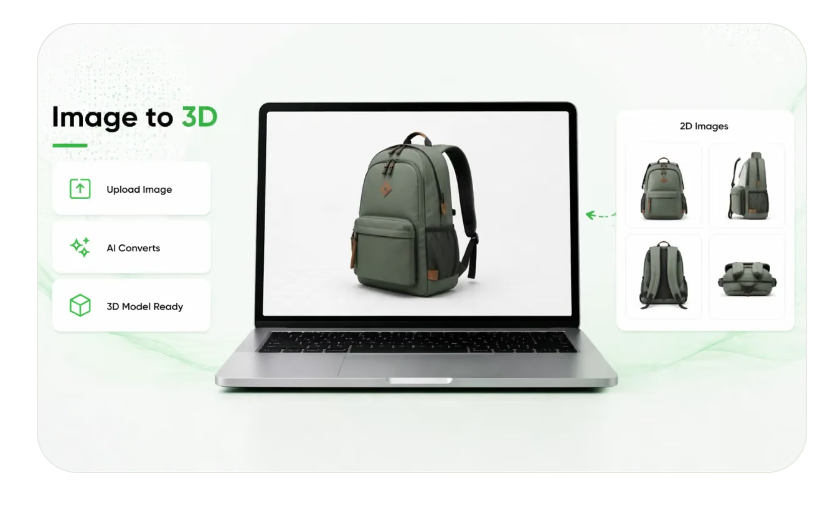
An Image to 3D workflow can produce a three-dimensional representation from supplied visual references, giving teams an initial model to inspect and refine. During evaluation, reviewers should determine whether the generated geometry reflects the actual product rather than simply resembling its most recognizable features.
This examination should include the object's silhouette, depth, surface transitions, and the relationship between connected parts. A model may look convincing from its original viewing angle but reveal distorted geometry when rotated. The rear of a product might contain missing surfaces, while curved sections could appear uneven or unusually thick.
It is also important to distinguish between visual resemblance and dimensional accuracy. A generated model might reproduce the general appearance of a chair, architectural fixture, or decorative panel without matching the product's exact measurements. The evaluation process must establish whether the model is suitable for the particular decisions being made.
If the model will only communicate a general design concept, some minor differences may be acceptable when clearly disclosed. If it will support dimensional coordination or product selection, a much higher level of accuracy is necessary.