
Your Gateway to Growth and Success!
Your Gateway to Growth and Success!


divya Patel
divya.incisivegrowth@gmail.com
08780467056
29 ganesh 3 Gandhinagar - 382007
A plumbing company owner once showed me a report from his previous agency: 84 leads that month, cost per lead right around industry average, everything looking fine on paper. Then he showed me his dispatch board. Nineteen jobs actually got scheduled. Nobody at the agency could explain the gap, because nobody was looking at his schedule — only at their own dashboard.
This is one of the most common blind spots in home service digital marketing, and it's worth understanding before you spend another dollar on ads, SEO, or anything in between.
Every home service business HVAC, plumbing, roofing, electrical, pest control, landscaping runs into the same disconnect eventually. A lead is just someone who called or filled out a form. A booked job is revenue actually scheduled. The gap between those two numbers can be enormous, and most reporting from a typical digital marketing agency for home services never bridges it.
Here's why that gap matters more than people expect. Imagine two campaigns running side by side, same monthly spend:
Campaign A wins every report built around cost per lead. Campaign B is the one actually paying your crew's wages. If your home services marketing agency is only reporting the cheaper-looking number, you could be scaling the wrong campaign without ever realizing it.
Booking rate isn't random it's driven almost entirely by intent. A broad keyword like "cheap plumber near me" pulls in a completely different kind of caller than "emergency pipe burst repair tonight." The first is comparison shopping across three or four quotes. The second has water actively damaging their home right now and is ready to book whoever answers first.
Generic home services online marketing that treats every keyword and every campaign the same way misses this distinction constantly. Emergency-intent traffic and price-shopper traffic need to be separated different budgets, different messaging, sometimes entirely different campaigns because lumping them together lets the cheaper, lower-intent traffic quietly dilute performance across the whole account.
For most home service searches, the local map pack gets seen and clicked before anyone even scrolls to the organic or paid results below it. This is why a proper home services SEO agency spends so much early effort on Google Business Profile completeness, service area accuracy, and review volume these directly affect whether you show up in the map pack at all, in every town you actually serve, not just the one your office happens to sit in.
A business that only appears in the map pack for its home suburb and vanishes two towns over usually has a service area configuration problem, not a demand problem. Fixing that is often faster and cheaper than any bid increase.
Homeowners comparing three contractors in the map pack tend to filter on star rating before they read a single review in detail. A business sitting at 4.2 stars for two years is losing a meaningful share of comparison traffic to competitors with stronger, more recently updated ratings, even when the actual quality of work is comparable. A consistent review generation process asking happy customers directly, right after the job is one of the highest-leverage, lowest-cost improvements available to almost any home service business.
HVAC has two demand spikes a year with long quiet stretches between them. Roofing sees storm-driven surges that don't follow a predictable calendar. Pest control shifts by season and by pest. A flat monthly budget that doesn't account for this tends to overspend in slow months and run out of budget in exactly the week demand peaks. Effective home service digital marketing budgets bend with seasonal and event-driven demand instead of staying static year-round.
Local Service Ads sit above regular paid search results, charge per lead rather than per click, and carry the Google Guaranteed badge which matters enormously for emergency and same-day work where trust needs to be established instantly. But LSAs offer very little control over targeting or messaging. Google Ads costs more per click but lets you control exactly which services, neighborhoods, and hours you show up for.
Running only one or the other leaves value on the table. A digital marketing home services strategy built around both, managed together rather than as separate, disconnected line items, tends to outperform either channel run in isolation.
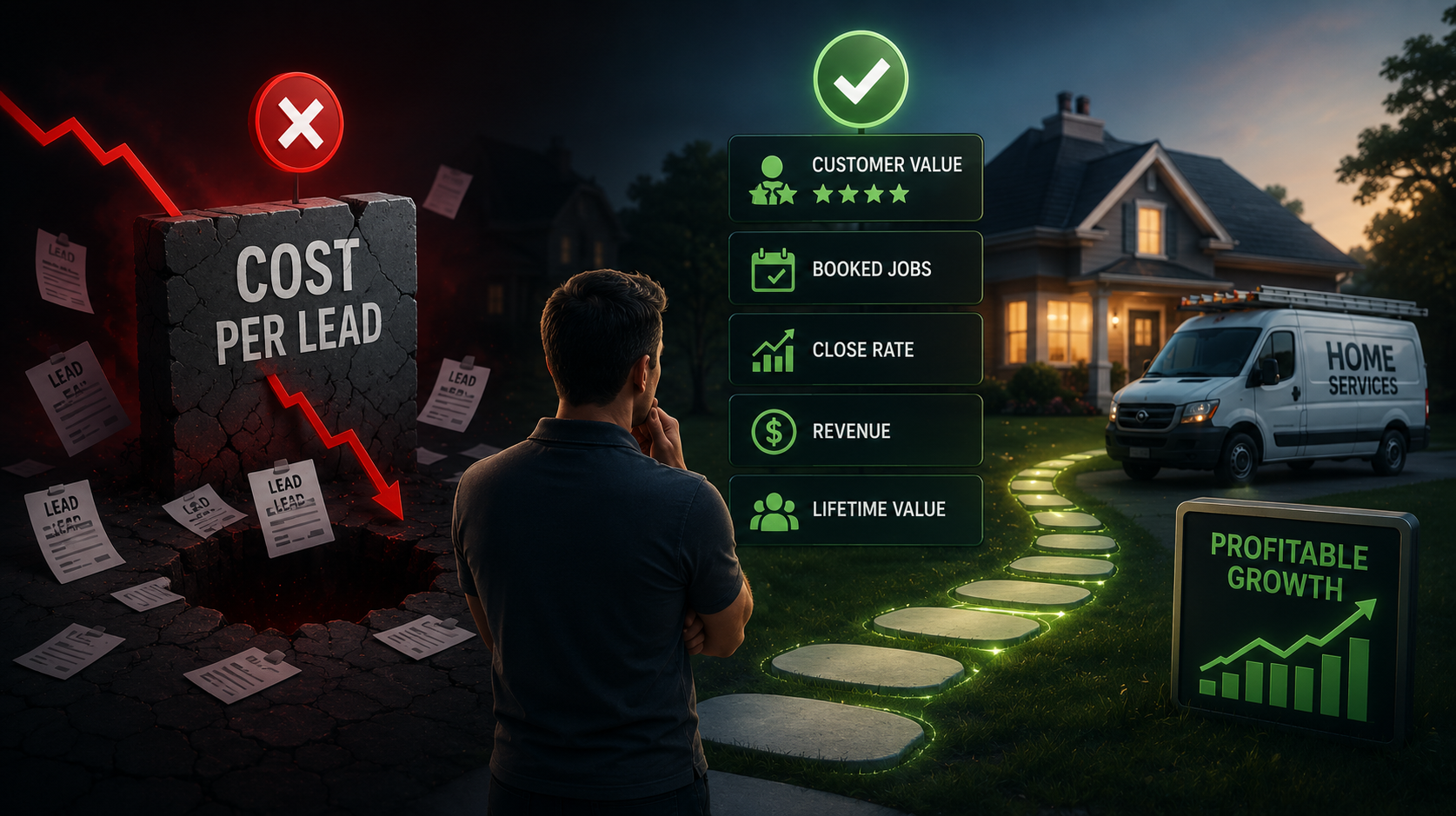
If you're evaluating a home services marketing company, one question cuts through most of the marketing noise faster than anything else: do you report against cost per lead, or cost per booked job?
An agency reporting only cost per lead has no visibility into or no incentive to fix the gap between leads and actual scheduled revenue. An agency that ties call tracking, form source tagging, and booking outcomes back to a single cost-per-booked-job number is measuring the thing that actually determines whether your marketing spend is profitable.
It's tempting to respond to a slow month by increasing ad spend. But if the underlying measurement is broken — no call tracking, no booking outcome recorded against each lead, campaigns mixing emergency and price-shopper intent together — more budget just scales the same blind spot faster. Getting call tracking, source tagging, and booking data in place first shows you where the real gap is before you spend another dollar trying to guess at it.
Home services marketing has a structural problem most reporting ignores: cost per lead looks measurable and clean, but it doesn't reflect what actually pays your team. The businesses getting the most out of their marketing spend are the ones measuring cost per booked job specifically, separating emergency from price-shopper intent, keeping local presence accurate across their full service area, and treating reviews as an ongoing priority rather than a one-time setup task. If your current reporting only shows you leads, it's worth asking what your actual dispatch board says by comparison — that gap is usually where the real opportunity is hiding.
For a documented example of what fixing this measurement gap can look like in practice, one home service business's account went from paying $2,107 per lead to $31.87 after this exact kind of rebuild by a home services marketing agency focused on cost per booked job rather than cost per lead alone.